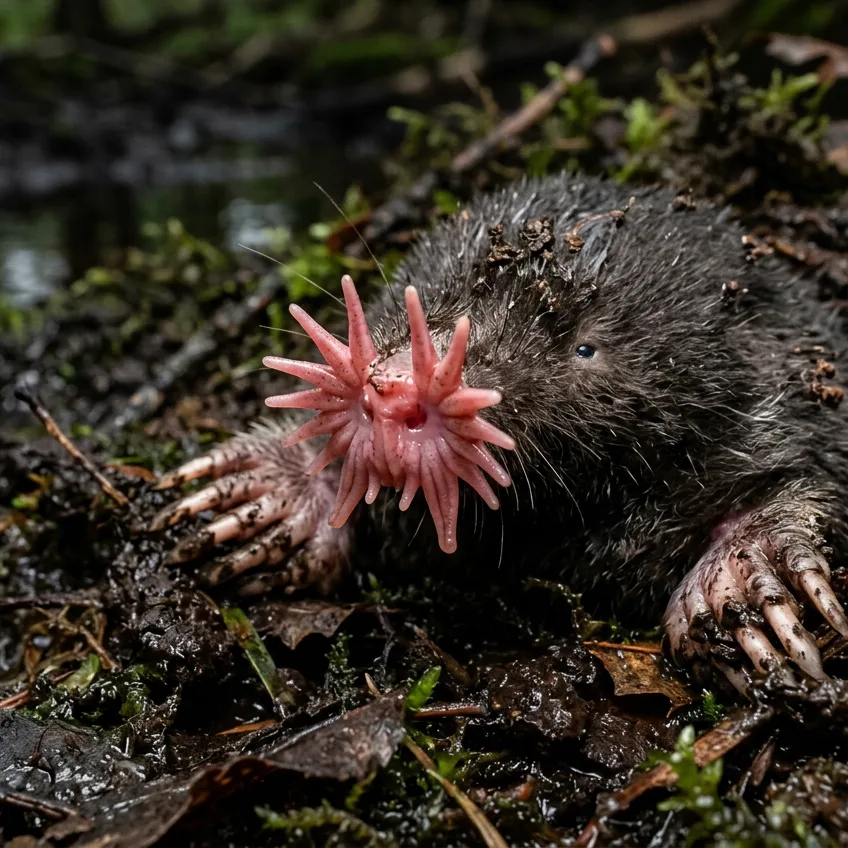
Beneath the peatlands and wetlands of eastern North America lives one of the most unique creatures on Earth: the star-nosed mole (Condylura cristata). Instead of a rigid or conventional snout, it sports a frontal crown of twenty-two pink fleshy appendages in constant motion, which function together as an astonishing 'tactile retina.'
This structure is covered with more than twenty-five thousand Eimer's organs, sophisticated microscopic mechanoreceptors connected to more than one hundred thousand nerve fibers. The sensory density of this organ is so vast that the animal's cerebral cortex dedicates most of its somatosensory map solely to processing information from the nasal star. This translates into two unique evolutionary marvels:
- Record neurological processing: Neurobiologist Kenneth Catania demonstrated that it is the fastest foraging mammal known. It can touch an object, determine if it is edible, and swallow it in just two hundred thirty milliseconds (less than a quarter of a second). Its brain makes the decision to classify prey in just eight milliseconds, bordering on the physical limit of the speed of nerve impulse propagation.
- Underwater olfaction using bubbles: For centuries, science considered it impossible for a mammal to smell while submerged. However, the star-nosed mole exhales tiny air bubbles against underwater objects and sediments to trap scent molecules and immediately inhales them back, repeating this cycle up to ten times per second to track worms in the water.
Practically blind and dependent on subterranean darkness, this marvel of bioengineering turns tactile contact and fluid dynamics into a relentless hunting machine.
Source: Vanderbilt University / Nature (Research by Dr. Kenneth Catania on Condylura cristata)