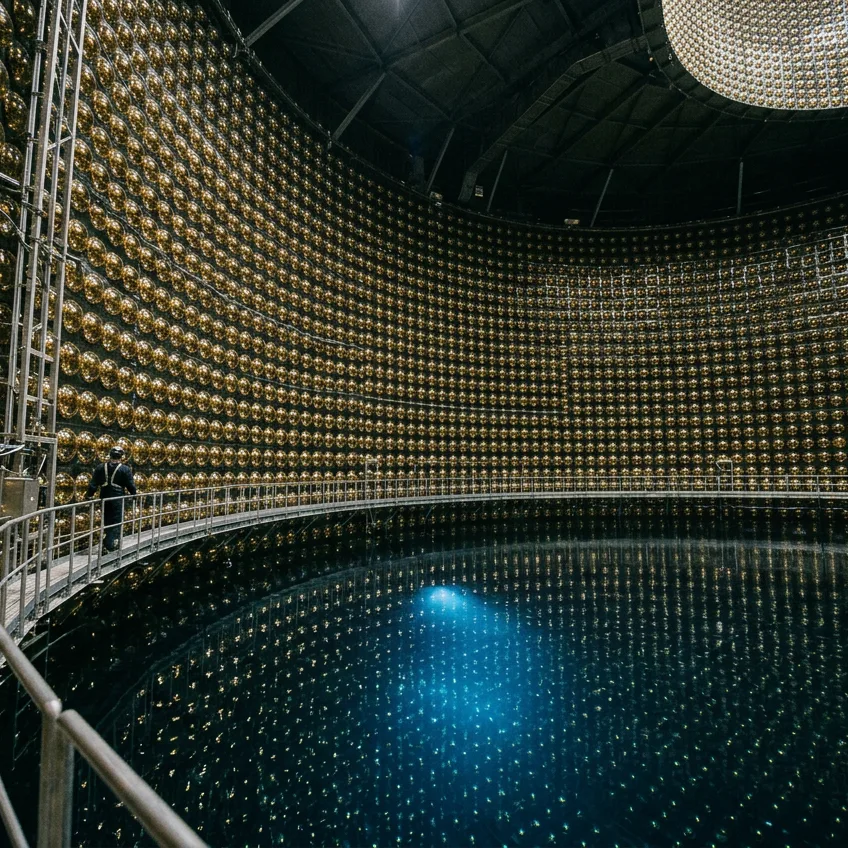
One kilometer deep under Mount Ikeno, in Japan, lies hidden one of the most astonishing scientific facilities on the planet: Super-Kamiokande. This massive stainless-steel cylinder, measuring more than 41 meters in height and diameter, houses 50,000 tons of water so unimaginably pure that it acts aggressively against any ordinary substance.
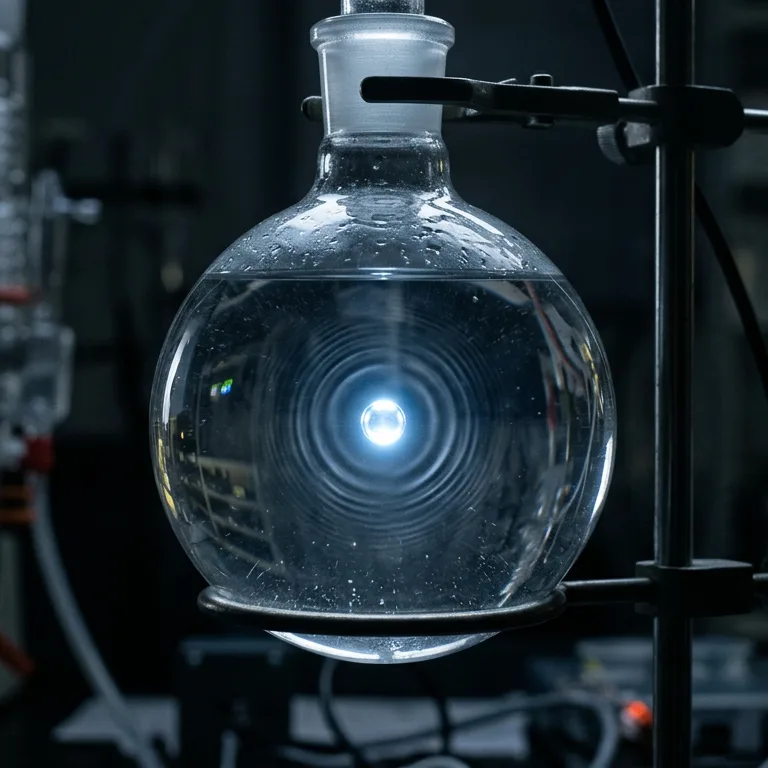
To detect neutrinos—subatomic particles without electrical charge and with tiny mass that pass through solid matter as if it did not exist—physicists require the medium to be chemically perfect. The water undergoes a relentless circuit of reverse osmosis filters, degassers, and ultraviolet light. By losing all its dissolved ions and salts, the liquid acquires such extreme chemical hunger that it leaches minerals from metal alloys, degrades common plastics, and can quickly exfoliate human skin.
The perimeter of the underground sanctuary is lined with more than 11,000 photomultiplier tubes: colossal golden vacuum spheres hand-blown by the Japanese firm Hamamatsu. When a neutrino fortuitously impacts the nucleus of a water molecule, it ejects a particle at a speed greater than that of light traveling through water. This phenomenon triggers a faint bluish halo known as Cherenkov radiation, the optical analog of a sonic shock wave.
In 1998, this particle telescope proved that neutrinos oscillate between different states and therefore have mass; a colossal discovery that amended the Standard Model and was awarded the Nobel Prize in Physics in 2015.
Source: Institute for Cosmic Ray Research (ICRR), University of Tokyo