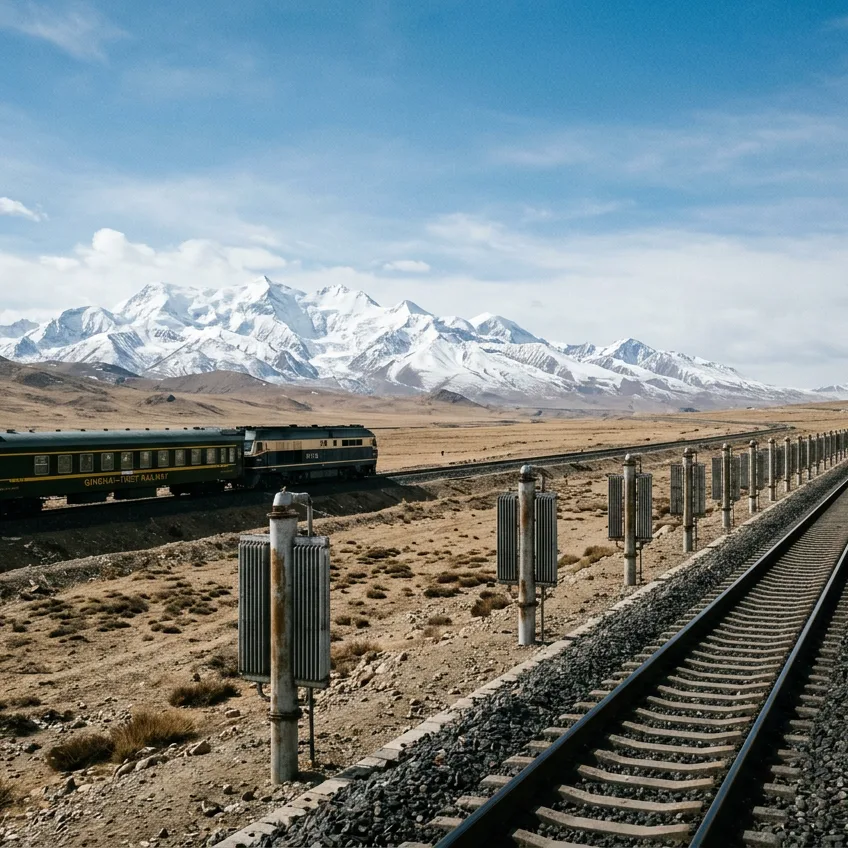
Building a railway at over 5,000 meters in altitude is a titanic challenge, but on the Tibetan plateau the greatest enemy was not the lack of oxygen, but the ground itself. The Qinghai-Tibet Railway, opened in 2006, crosses about 550 kilometers of permafrost, a layer of soil and ice that remains frozen for much of the year. The geotechnical problem was critical: the heat absorbed by the dark ballast of the tracks and climate change threatened to melt the ground in summer, turning it into soft mud that would collapse the rails.
To avoid a catastrophe without relying on an electrical grid impossible to maintain on the desolate plateau, engineers turned to a marvel of passive thermodynamics: two-phase thermosiphons. These are tens of thousands of vertical metal tubes driven several meters deep on both sides of the track, sealed and filled with liquid ammonia.
These tubes act as a one-way thermal diode:
- In winter: The outside air is colder than the subsoil. The ammonia at the bottom absorbs residual heat from the ground, boils, rises as a gas, and condenses on the upper fins exposed to the freezing wind, releasing the heat into the atmosphere and dripping back down to the bottom.
- In summer: The outside air warms up, but because hot gas cannot naturally descend by convection, the cycle stops completely, preventing surface heat from penetrating the subsoil.
Thanks to this heat pumping that is completely autonomous and has no engines, the permafrost remains supercooled throughout the year, ensuring the stability of the highest passenger line on the planet.
Source: American Society of Civil Engineers (ASCE) / Cold Regions Science and Technology