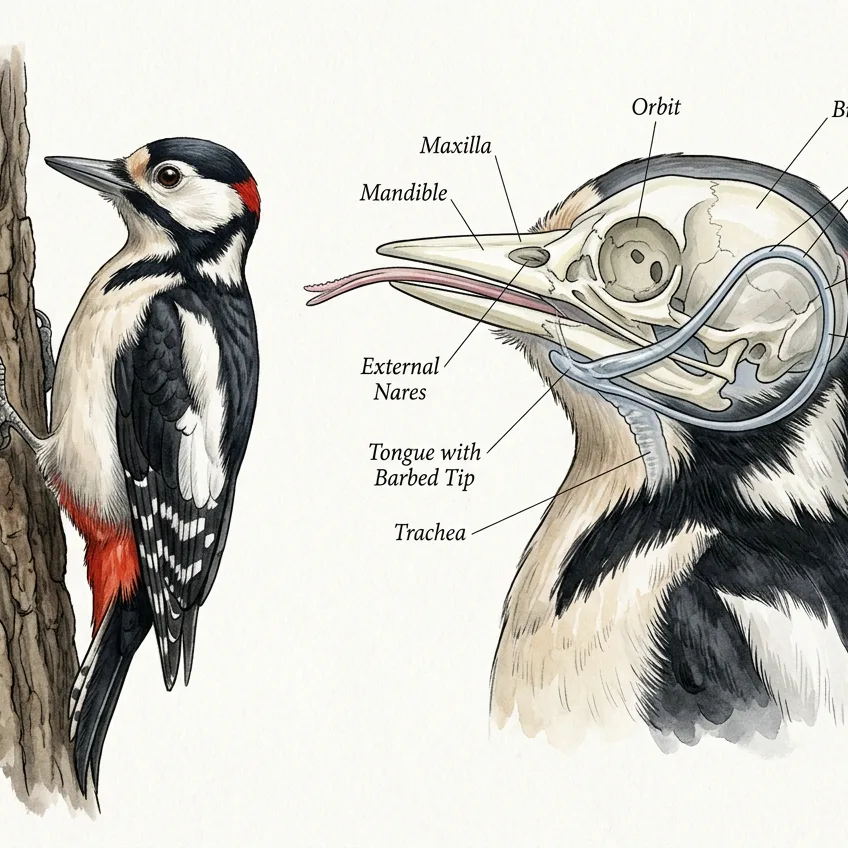
When a woodpecker hammers the bark of a trunk to hunt or carve its nest, it collides at about 25 km/h and repeats the movement up to 20 times per second. This action subjects its head to decelerations of up to 1,200 g. By comparison, a human experiences concussions or fatal trauma with impacts that barely exceed 80 or 100 g. The reason this bird does not suffer neuronal damage lies in a masterpiece of evolutionary biomechanics.
The most fascinating element of its defense is the hyoid apparatus. Instead of merely supporting the tongue as in other vertebrates, this long, elastic bone divides into two branches that travel backward, ascend completely wrapping around the back and top of the skull, and rejoin over the forehead or near the nostrils. This structure acts as a true elastic harness or seat belt that distributes and dissipates shock waves around the cranial vault.
To this ingenuity are added other critical adaptations:
- Trabecular spongy bone: Its skull features porous microstructures specifically oriented to cushion high-frequency mechanical vibrations.
- Millimetric brain fit: It has almost no free cerebrospinal fluid, which prevents the brain from 'sloshing' or hitting the inner bone walls.
- Protective eyelid: Milliseconds before each impact, a thick nictitating membrane closes so that the massive deceleration does not dislocate its eyeballs.
Source: Journal of Experimental Biology (2011) / Nature Scientific Reports