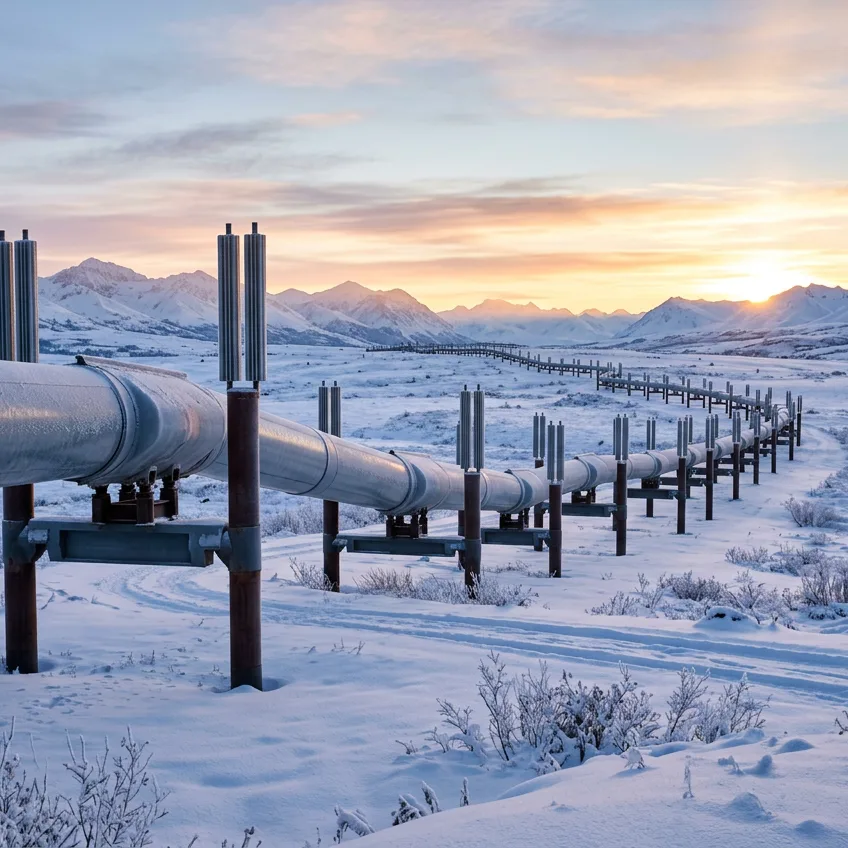
Building the Trans-Alaska Pipeline in the mid-1970s presented a colossal thermodynamic and structural dilemma: pumping hot crude oil at over 50 °C along 1,287 kilometers of frozen tundra threatened to melt the permafrost, which would have caused ground subsidence and catastrophic pipe fracture.
To overcome this obstacle without consuming electricity in remote landscapes, engineers relied on more than 120,000 passive thermosiphons. These hollow steel pipes, topped by distinctive aluminum-finned radiators, contain vacuum-sealed anhydrous ammonia. During cold months, residual heat from the subsoil evaporates the ammonia at the bottom of the support; vapor rises toward the frigid atmosphere, condenses at the top while dissipating heat, and flows back down via gravity. This perpetual cycle actively draws heat from the ground, keeping the permafrost frozen and solid as rock beneath the foundations.
Additionally, to shield the infrastructure against active tectonic faults, the route was built in a unique zigzag pattern. The pipe rests loosely on horizontal beams fitted with Teflon slider shoes, allowing it to act like an elastic bellows. The ultimate test arrived in 2002 during the 7.9-magnitude Denali earthquake: the ground tore apart, shifting 5.5 meters horizontally, but the pipeline simply glided along its supports without spilling a single drop.
Source: American Society of Civil Engineers (ASCE) / Alyeska Pipeline Service Company