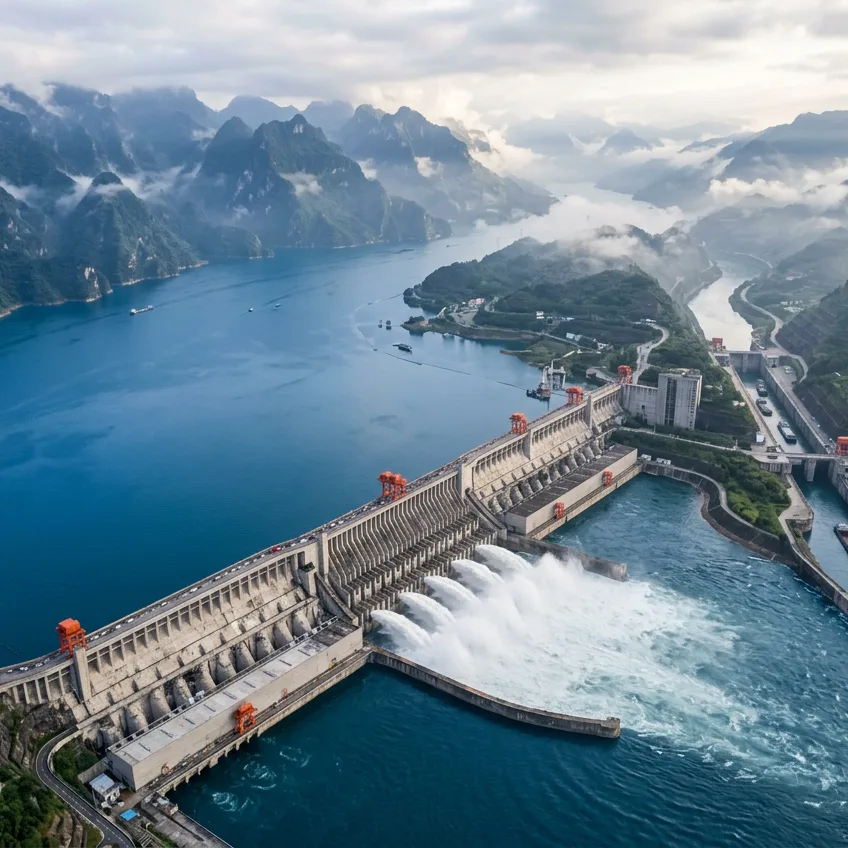
Inaugurated on the Yangtze River in China's Hubei province, the Three Gorges Dam is the most powerful hydroelectric power station in the world. At 2,335 meters long, 181 meters high, and consuming 28 million cubic meters of concrete, it boasts colossal dimensions. However, its most astonishing impact lies not in its capacity to generate electricity, but in its measurable effect on Earth's celestial mechanics.
When the dam operates at maximum capacity, its reservoir holds around 39,300 million cubic meters of water at 175 meters above sea level. Raising such a liquid volume to that altitude is equivalent to shifting an approximate mass of 39 trillion kilograms away from the center of Earth. In rotational physics, moving mass away from the axis of rotation increases the body's moment of inertia, just as happens to a figure skater who extends her arms to spin more slowly.
In 2005, NASA geophysicist Richard Gross calculated the impact of this colossal shift in mass: the concentration of water caused the length of an Earth day to increase by 0.06 microseconds and shifted the planet's rotational axis by about two centimeters at the pole. Although this fraction is imperceptible to humans, it makes this monument of modern engineering the only civil infrastructure in history capable of demonstrably altering the spin of our own planet.
Source: NASA Jet Propulsion Laboratory (Geodynamics calculations by Richard Gross, 2005)