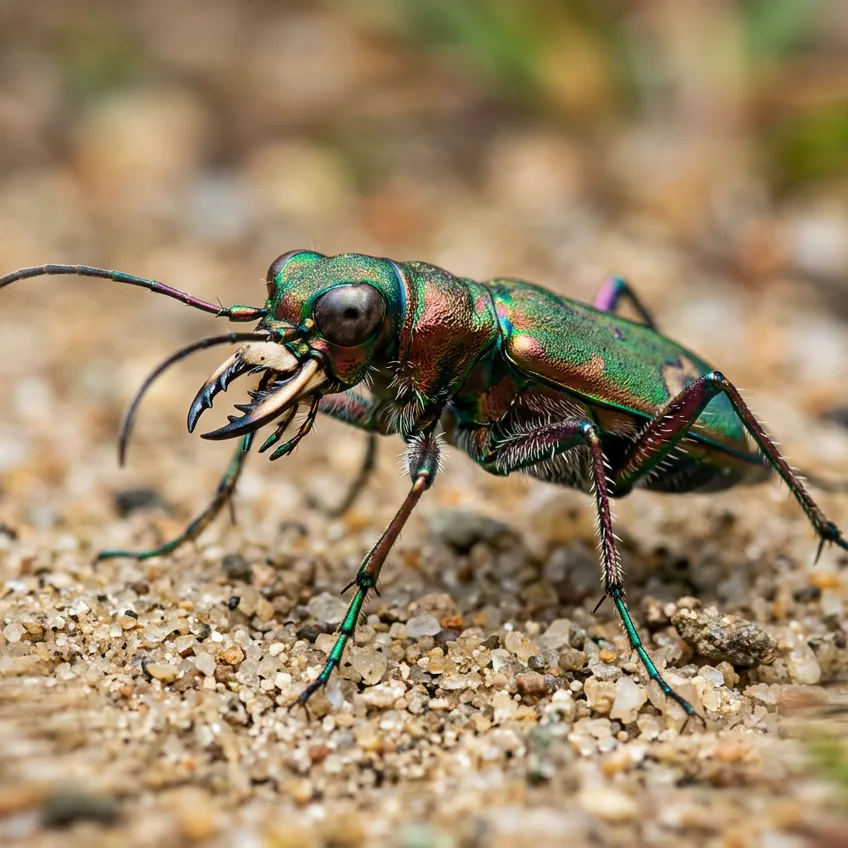
In the microscopic world, the tiger beetle (subfamily Cicindelinae) holds one of the planet's most astonishing kinetic records. The Australian species Cicindela hudsoni can move at 2.5 meters per second, which equals covering about 125 times its own body length in a single second. On a human scale, this biomechanical feat would represent an athlete running at over 770 kilometers per hour.
However, such acceleration carries an unusual biological toll: the beetle suffers temporary blindness every time it starts a full-speed sprint. For the insect's compound eye to perceive its surroundings, its photoreceptors need to absorb a minimum amount of photons per millisecond and process the information neuronally. At maximum propulsion, the insect moves faster than its photoreceptors can capture and refresh light, causing its visual world to turn completely blurred and dark.
To solve this design flaw without giving up on lunch, the tiger beetle developed a fascinating technique: intermittent hunting. It runs blind in explosive bursts toward where it last saw its prey, stops dead in its tracks for a fraction of a second to regain vision and readjust its coordinates, and accelerates blindly once again. In addition, it extends its long antennae forward like tactile bumpers to avoid crashing into obstacles along the way.
Source: Cole, G. B. & Gilbert, C. (Cornell University) / Journal of Experimental Biology



