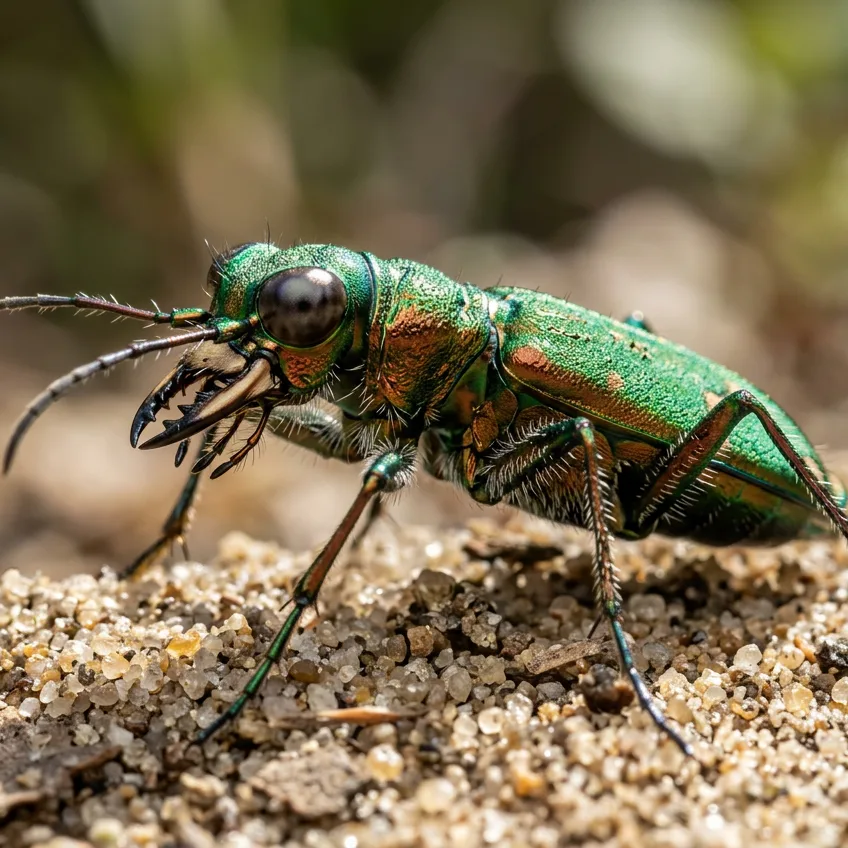
In the animal kingdom, speed is usually synonymous with an evolutionary advantage, but the tiger beetle (genus Cicindela) takes this principle so far to the extreme that it challenges the limits of sensory physics. Proportionately to their body size, these small predators are among the fastest land animals on Earth: they reach speeds of up to 2.5 meters per second, which is equivalent to covering about 120 times their body length in a single second. If a human ran at that relative scale, they would comfortably exceed 700 kilometers per hour.
However, this colossal speed carries an unusual toll: the insect goes temporarily blind while running. Pioneering research by entomologist Cole Gilbert at Cornell University showed that the tiger beetle's compound eyes cannot capture enough photons at that dizzying acceleration to reconstruct a continuous image in its brain. The visual processing rate collapses before the burst of stimuli, plunging the predator into absolute perceptual darkness during the sprint.
To navigate this evolutionary dilemma, the tiger beetle has developed a unique strategy of interval hunting:
- Localization phase: It stops dead in its tracks, processes the visual position of its prey, and plots a fixed trajectory.
- Blind attack: It rushes toward the target at maximum power visually disconnected, using its long rigid antennae as tactile sensors to avoid crashing.
- Correction and capture: It brakes suddenly to 'recover its sight', readjusts the coordinates, and delivers a final, accurate bite with its serrated mandibles.
Source: Cornell University / Nature (Research by Dr. Cole Gilbert on the locomotion and vision of Cicindela)