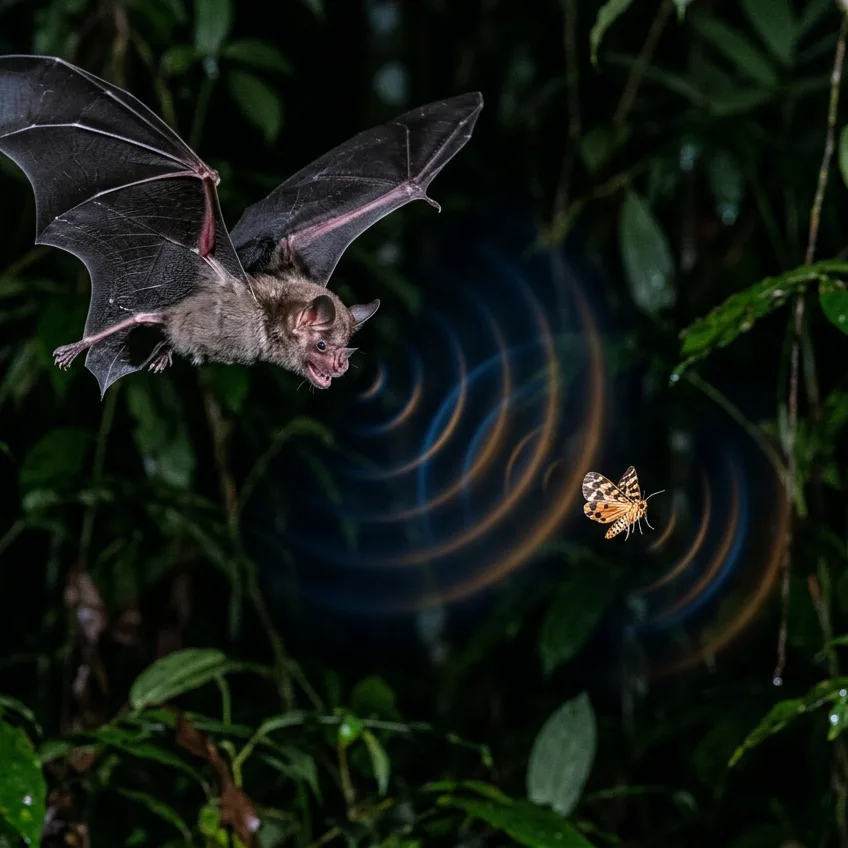
For tens of millions of years, insectivorous bats have dominated the night thanks to their echolocation: they emit ultrasonic pulses and calculate the delay of the acoustic rebound to locate their prey with millimeter precision. However, in 2009, researchers at Wake Forest University documented that a modest nocturnal species, the Neotropical tiger moth (Bertholdia trigona), possesses an unprecedented defense: active sonar jamming.
Unlike other insects that merely dodge the hunter or warn of their foul chemical taste, this moth uses elastic structures on its thorax called tymbals to fire bursts of up to 4,500 ultrasonic clicks per second at the exact moment it detects the bat entering its final approach phase.
This acoustic bombardment completely disrupts the predator's auditory processing through two mechanisms:
- Echo distortion: The insect's pulses overlap and mask the bat's real echo, creating an auditory illusion regarding the prey's true distance and trajectory.
- Massive attack failure: Unable to synchronize the moment of capture, the bat misses more than 80% of its strikes, forced to give up.
This phenomenon represents the first confirmed example in the animal kingdom of pure acoustic electronic warfare, where biological evolution anticipated the principles of radar jamming developed by human engineering.
Source: Science (Corcoran, Barber & Conner, 'Tiger Moth Jams Bat Sonar', 2009)



