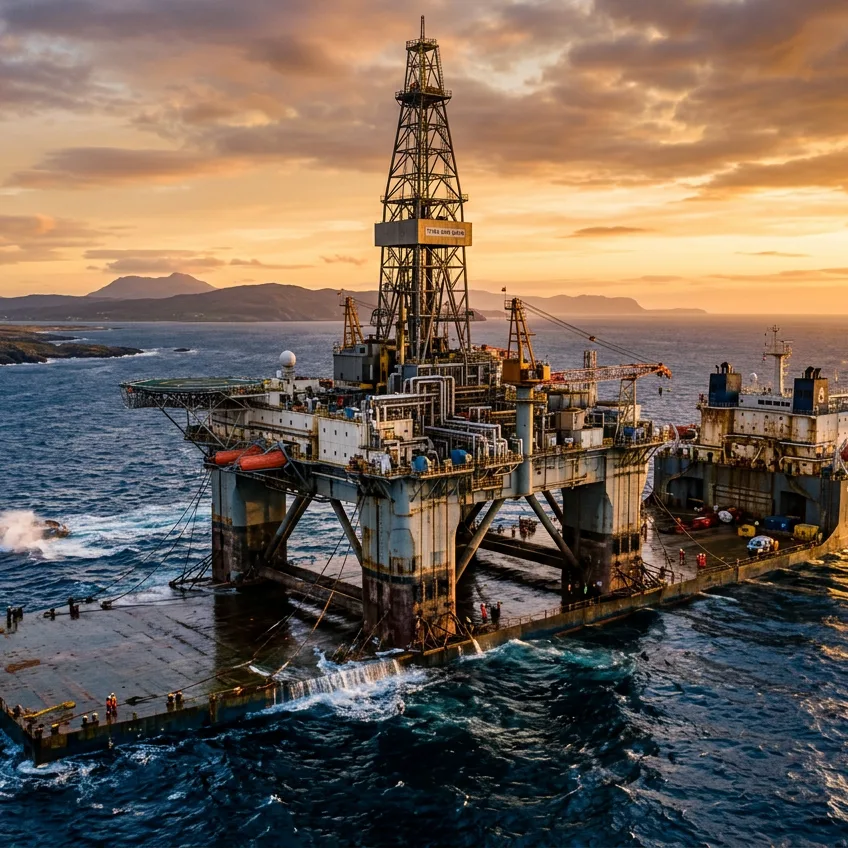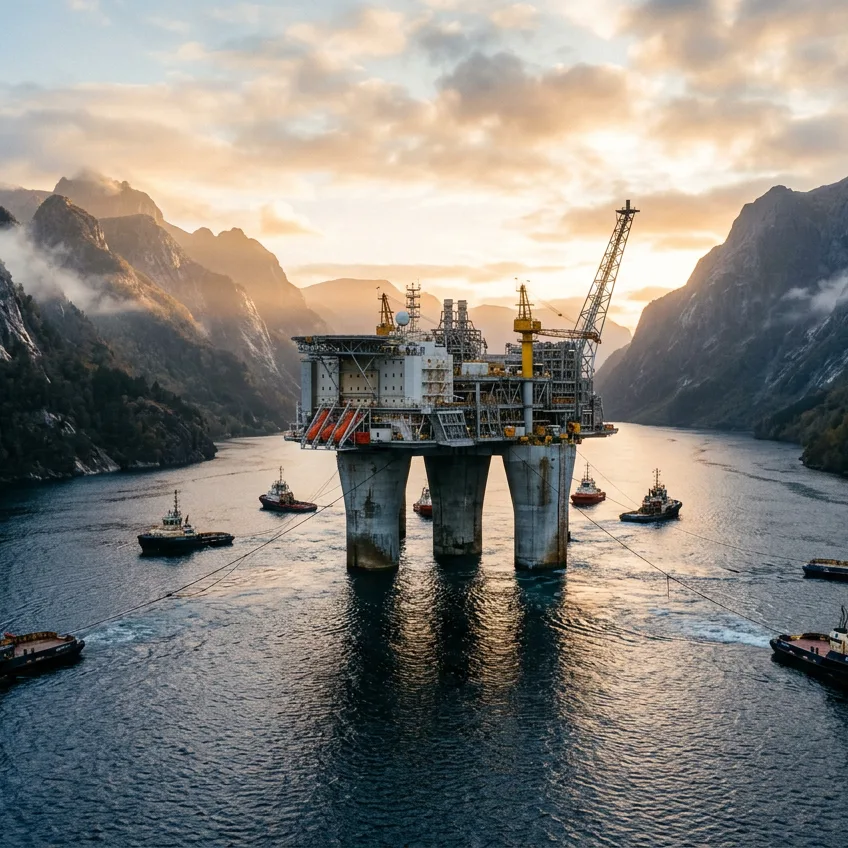
In May 1996, the coasts of Norway witnessed one of the greatest logistical and engineering feats in history: the marine relocation of the Troll A gas platform. With an astonishing total height of 472 meters—surpassing the height of the Empire State Building—and a ballasted mass reaching 1.2 million tons, it became the heaviest structure humanity has ever moved across the surface of the planet.
To float and move such a submerged skyscraper, engineers had to overcome monumental physical challenges:
- Continuous construction in fjords: Its four gigantic hollow reinforced-concrete legs were poured without interruption using slipforming to prevent cracks or weak expansion joints under the pressure of the abyss.
- The tugboat procession: A synchronized fleet of 10 naval tugboats towed the mass at a top speed of barely 1.8 knots (approximately 3.3 km/h), covering more than 200 kilometers across open sea with a margin of maneuver of just centimeters.
- Suction anchoring: At its destination in the North Sea, at a depth of more than 300 meters, the structure penetrated 36 meters into the seabed using an ingenious suction vacuum system, anchoring itself firmly without the need for conventional piles.
Designed to withstand hundred-year storms with waves exceeding 30 meters in height for more than 70 years, Troll A proved the ability of civil engineering to successfully design, float, and transport a genuine artificial mountain of concrete across the ocean.
Source: Guinness World Records / Equinor Technical Archives