Along the twenty-seven kilometers of the underground ring of the Large Hadron Collider (LHC), on the Franco-Swiss border, lies one of the most extreme environments in the cosmos, paradoxically created within Earth's crust. To allow two proton beams to circulate in opposite directions and collide one billion times per second, particles must travel without colliding with residual gas molecules, requiring one of the greatest technical feats in history.
The system features metal piping networks subjected to an ultra-high vacuum dropping to pressures of 10-10 millibars. Through turbomolecular pumps, ion traps, and special coatings of titanium, zirconium, and vanadium that absorb stray atoms, a particle concentration ten times lower than the tenuous atmosphere present on the lunar surface is achieved, surpassing the interplanetary vacuum in purity.
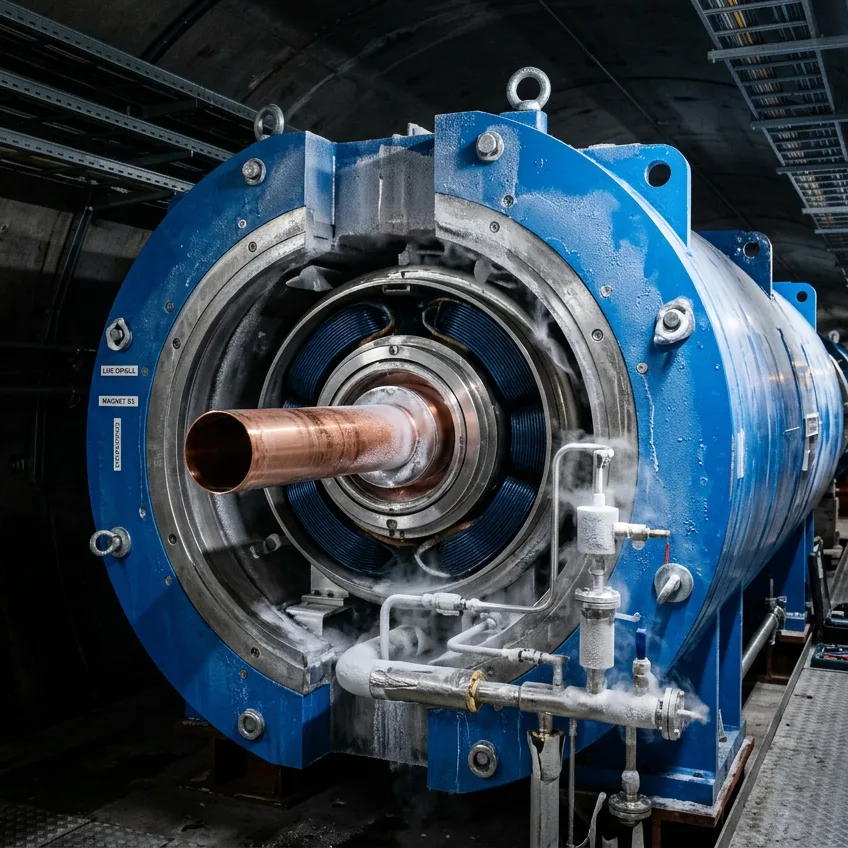
At the same time, the machine houses the most colossal cryogenic system on the planet. Around one hundred and twenty tons of superfluid liquid helium cool its 1,232 superconducting magnets to 1.9 Kelvin (-271.25 °C). This figure places the inside of the accelerator below the 2.7 Kelvin of the cosmic microwave background that permeates deep space. One hundred meters underground, particle physics daily recreates an abyss of vacuum and cold more inhospitable than outer space itself.
Source: CERN - European Organization for Nuclear Research (LHC Vacuum and Cryogenics Technical Reports)