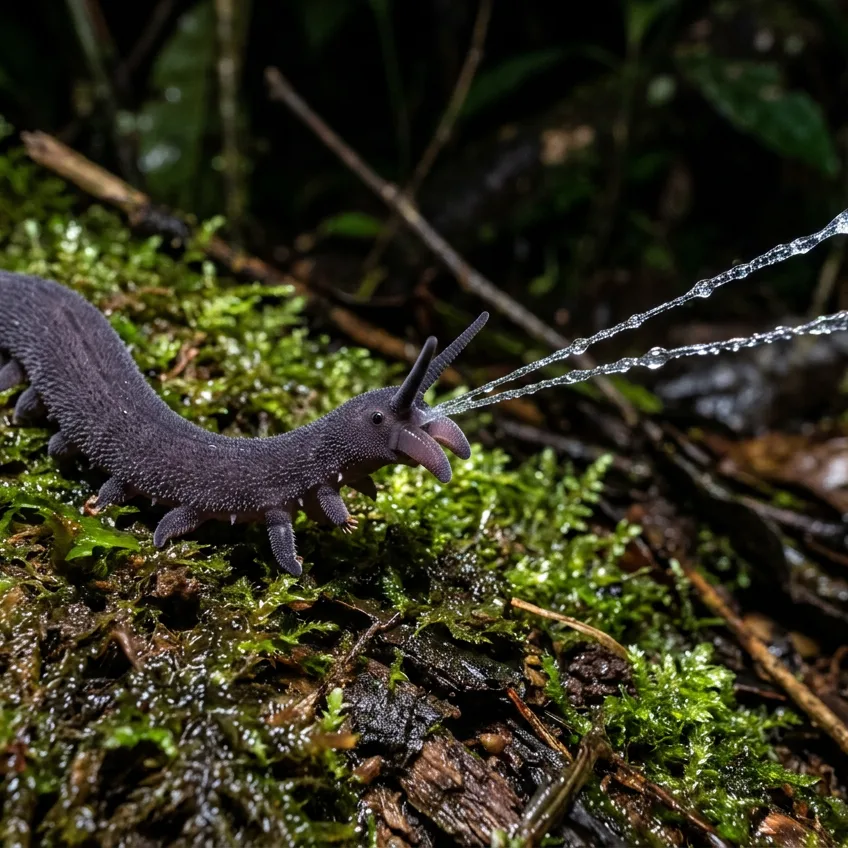
On the damp floor of tropical forests lives one of Earth's most unusual and ancient predators: the velvet worm (phylum Onychophora). Far from being a simple annelid, this living fossil has walked virtually unchanged anatomically for more than 500 million years, surviving mass extinctions that wiped out the dinosaurs.
Its hunting method seems taken from science fiction. Due to its poor vision and slow gait, the worm compensates for its stealth with a pair of oral papillae turned into biological cannons. When it detects the movement of an insect or spider through its sensitive antennae, it shoots two crisscrossing jets of a liquid secretion at speeds reaching up to five meters per second, covering a distance of up to 30 centimeters in just 60 milliseconds.
The physics behind this projectile is astonishing:
- Passive oscillation: The papillae vibrate chaotically during the shot without requiring complex muscles, spontaneously weaving a viscous net in midair.
- Instant hardening: The mixture, composed of soluble proteins and lipids, collapses under mechanical force and evaporation; in less than ten seconds it transforms into a rigid structure similar to nylon.
Once the victim is trapped and helpless, the worm pierces its exoskeleton with its retractable jaws, injects digestive enzymes, and drinks the liquefied interior, even recycling the protein from its own slime to avoid wasting resources.
Source: Nature Communications (Biomechanical studies on fluid oscillation in Onychophora, Harvard University and University of Kassel)