For centuries, Venice has fought a battle against acqua alta, the exceptional tides that flood historic squares like St. Mark's. Modern engineering's answer to this existential threat is the MOSE System (Electromechanical Experimental Module), a colossal hydraulic barrier designed to be completely invisible during calm days.
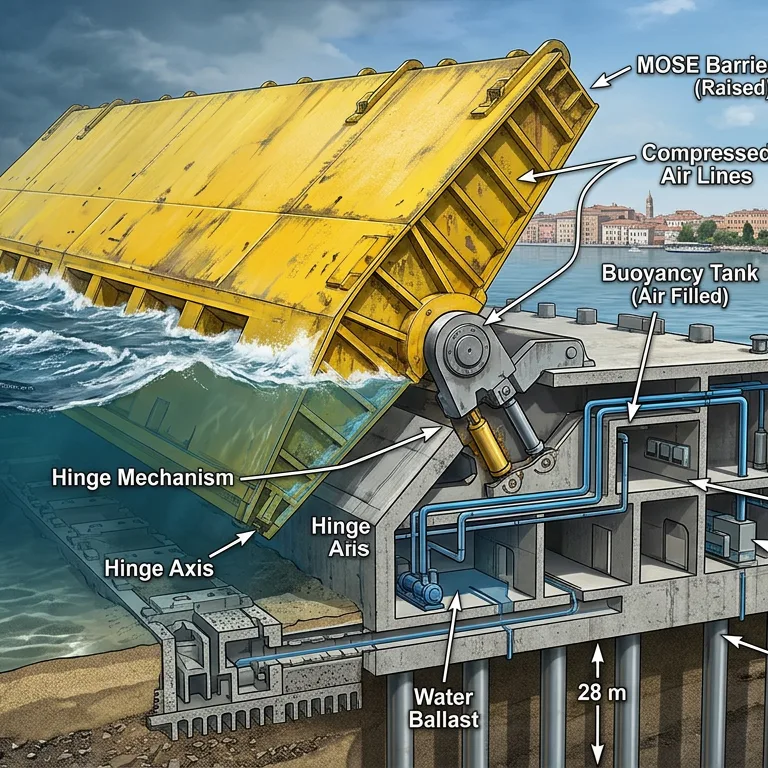
The system consists of 78 oscillating metal gates distributed across the three inlets connecting the Venetian Lagoon with the Adriatic Sea: Lido, Malamocco, and Chioggia. Each gate measures up to 30 meters long, 20 meters wide, and weighs around 300 tons. Their design hides a hydrodynamic feat: under normal conditions, they remain filled with water, invisible, and resting inside giant concrete caissons sealed on the seabed.
When weather models forecast tides exceeding 110 centimeters, the maneuver begins:
- Pneumatic injection: Compressed air is pumped into the gates, expelling the water inside them outward.
- Buoyancy rotation: Driven purely by buoyant force, the barriers rotate on gigantic 42-ton hinges and rise at an angle of up to 45 degrees.
- Total isolation: In just 30 minutes, the gates form a continuous wall that blocks the Adriatic Sea and stabilizes the lagoon's water level.
In October 2020, the system was successfully activated for the first time against a tide of 135 centimeters, keeping the iconic Venetian square completely dry.
Source: Consorzio Venezia Nuova / Ministero delle Infrastrutture e dei Trasporti (Italy)