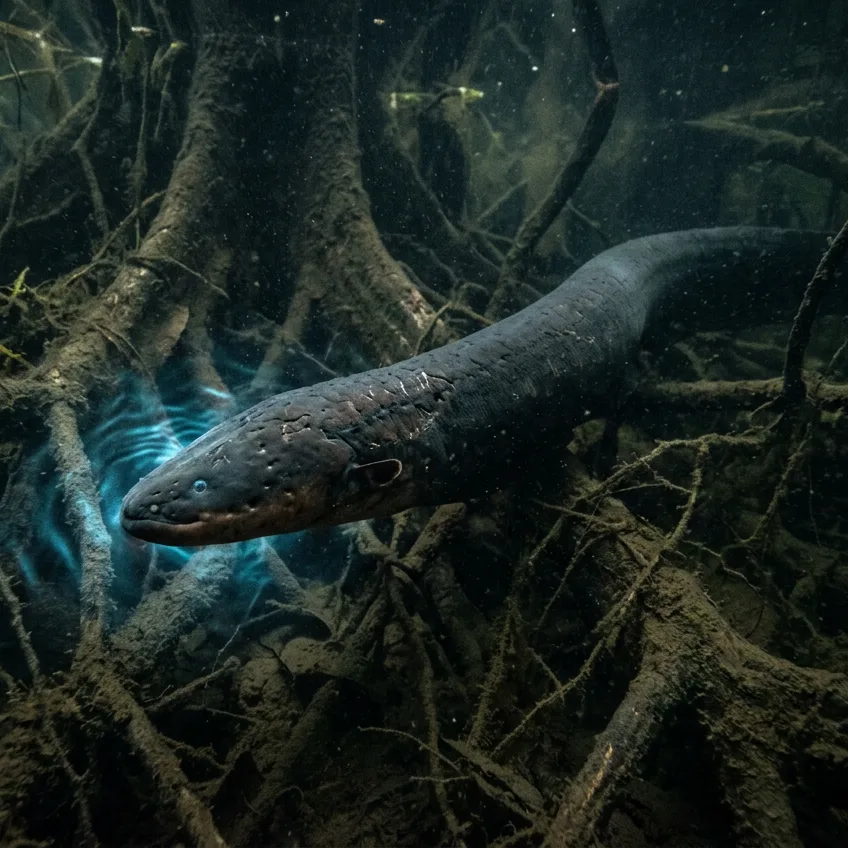
For more than two and a half centuries, science believed that only one species of electric eel existed in the Amazon and Orinoco basins. However, in 2019, a taxonomic expedition led by the Smithsonian's National Museum of Natural History discovered that three distinct species actually coexisted. The most formidable of them, named Electrophorus voltai, shattered all known bioelectric records: it is capable of generating discharges of up to 860 volts, far exceeding the previous record of 650 volts and quadrupling the typical voltage of a household outlet in Europe.
Measuring over two meters in length, this fish houses three specialized electrogenic organs (the main organ, Hunter's organ, and Sachs' organ), which span about 80% of its body. These structures are composed of tens of thousands of disc-shaped cells called electrocytes, derived from modified muscle tissue. At rest, each electrocyte uses ion pumps to concentrate sodium and potassium ions, keeping its interior negatively charged.
When the eel detects prey or feels threatened, its brain sends a nervous signal coordinated by acetylcholine that reaches all cells in almost the exact same millisecond. The ion channels open abruptly, causing a polarity shift of about 0.15 volts per cell. Because they are arranged in long columns in series, like a gigantic biological battery, the tiny individual charges add up to unleash an electric shock of 860 volts and one ampere of current. With an instantaneous power close to one thousand watts, the discharge paralyzes the muscles of any nearby fish and is even capable of deterring adult caimans.
Source: Nature Communications (de Santana et al., 2019 - 'Unexpected species diversity in sluggish-moving electric eels with the description of two new species')