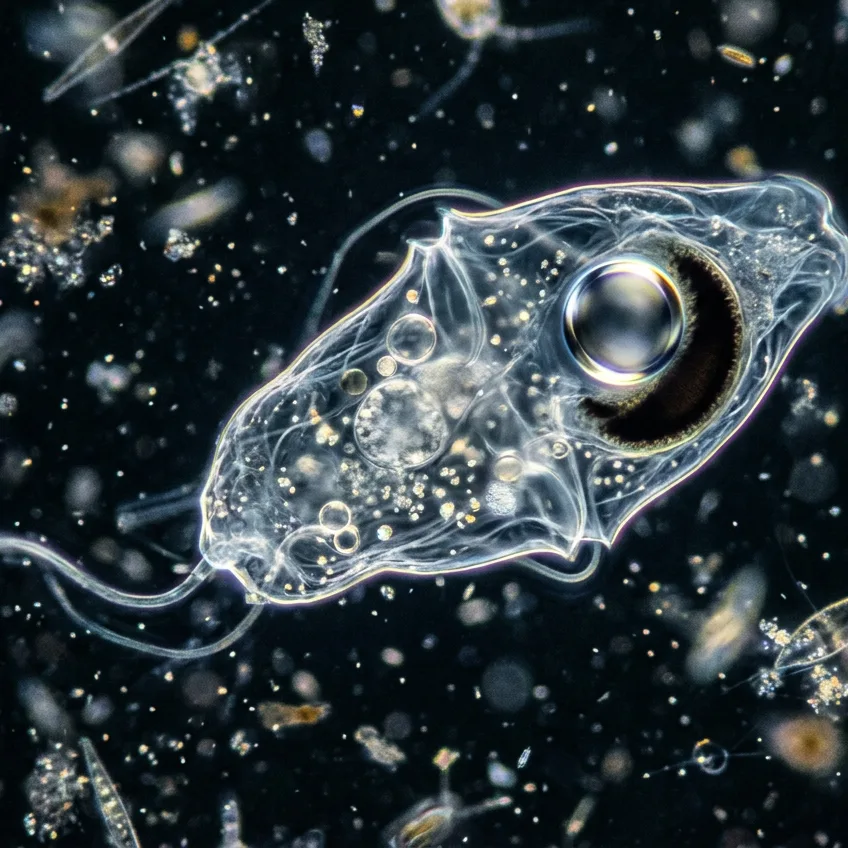
In the microscopic realm, sensing light is usually limited to primitive photoreceptors that can only distinguish brightness from darkness. However, warnowiids (Warnowiaceae), a lineage of marine single-celled dinoflagellates, broke all evolutionary rules by developing an ocelloid: an astonishingly complex eye-like structure that mimics the eye anatomy of multicellular animals within a single cell.
Discovered in the 19th century, they were mistakenly thought to be microscopic animals for decades due to the presence of this visual organ. It was not until 2015 that a team of biologists from the University of British Columbia, using high-resolution electron microscopy and cryo-tomography, unravelled its true nature. The ocelloid is not made of thousands of specialized cells, but rather of deeply modified and coordinated cellular organelles:
- The lens: A transparent, hyperdense lens built from dozens of fused mitochondria that precisely refract light.
- The retina: A curved photoreceptor network composed of membranes from an ancestral plastid, the remnant of a modified chloroplast that replaced photosynthesis with photonic detection.
- The cornea: An external protective dome formed by lipid vesicles that coat the lens.
Lacking a brain or neurons, these tiny hunters do not process images as we do. Instead, the ocelloid acts as a high-precision polarizing filter that detects reflections and shadows from their transparent prey in the water column, guiding microscopic filaments with which they harpoon other microorganisms with lethal accuracy.
Source: Nature (Gavelis et al., 2015 - 'Eye-like ocelloids are built from different endosymbiotically acquired components')