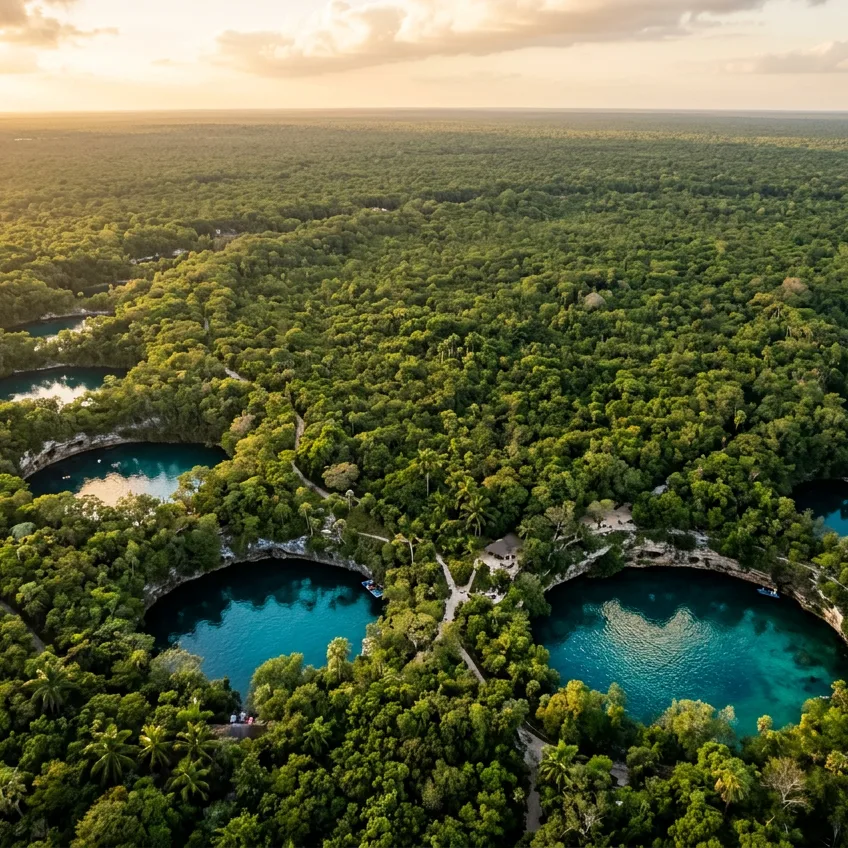
In the Yucatan Peninsula, hundreds of cenotes form a nearly flawless semicircle spanning more than one hundred and sixty kilometers in diameter. For centuries, the Maya regarded these flooded chasms as sacred entrances to the underworld, unaware that their unique geometric arrangement was the geological echo of the most violent event in the recent fossil record: the Chicxulub asteroid impact sixty-six million years ago.
The bolide, about ten kilometers in diameter, left no depression visible to the naked eye on the current landscape, as the original crater of nearly two hundred kilometers was buried beneath a kilometer of limestone sediments accumulated during the Cenozoic. However, the colossal energy released intensely pulverized and faulted the bedrock at the outer edge of the impact. This underground fracturing created a sharp structural and permeability discontinuity compared to the surrounding terrain.
Over the millennia, acidified rainwater took advantage of these concentric fractures to circulate preferentially and dissolve the carbonate rock at an accelerated rate. The roofs of underground caverns progressively collapsed, giving rise to the famous Ring of Cenotes:
- Millimeter alignment: The arc of natural sinkholes traces the buried peak ring of the impact crater with astonishing precision.
- Scientific confirmation: In the 1990s, hydrogeological maps and gravimetric data confirmed that this line of sinkholes coincided with the cosmic structure that sealed the fate of non-avian dinosaurs.
Today, this karst landscape represents one of the most fascinating hydrogeological anomalies on the planet: a living aquifer network shaped by chemical dissolution over the fractures of an extraterrestrial cataclysm.
Source: Nature / Geological Society of America (GSA)