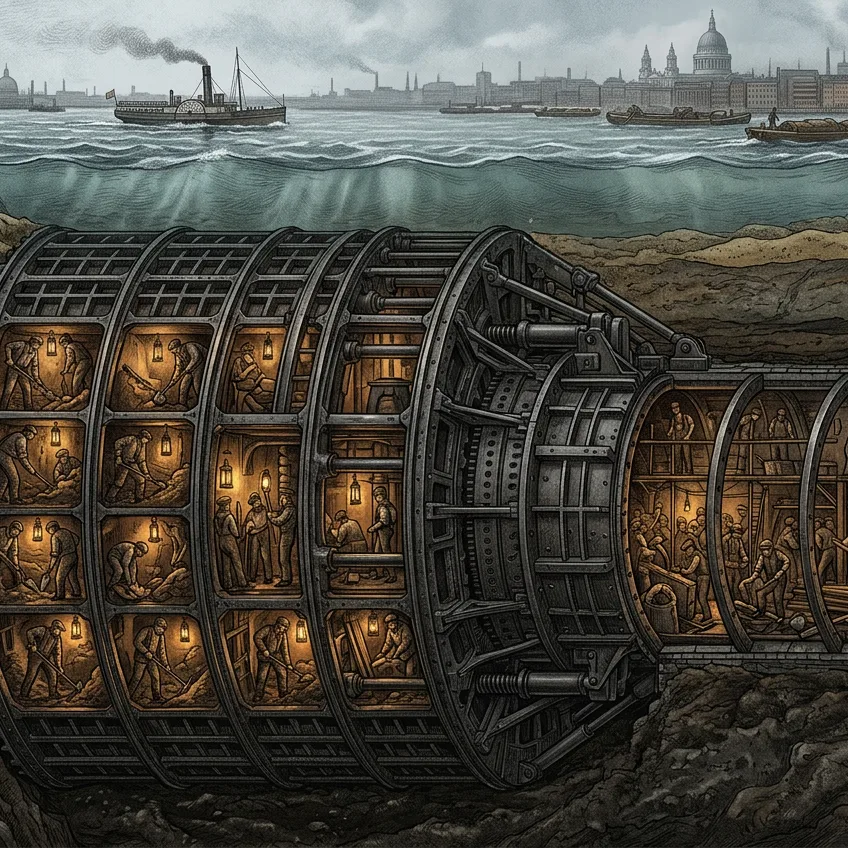
In the early 19th century, digging under large bodies of water was considered a death sentence. Soft mud and groundwater pressures collapsed any traditional gallery. The solution to the dilemma did not come from a mathematics treatise, but from the biological observation of French-British engineer Marc Isambard Brunel, who conceived history's first tunneling shield in 1818.
Brunel closely observed the behavior of Teredo navalis, a bivalve mollusk known as the shipworm, feared for devouring wooden hulls. He discovered that the mollusk used its hard frontal shell to scrape wood as it moved forward, simultaneously secreting a calcareous coating that lined and stabilized the newly bored tunnel behind it to prevent its collapse.
Inspired by this principle, he patented a colossal mobile cast-iron structure divided into 12 vertical frames and 3 levels of independent cells. In each cell, a worker removed front planks to excavate a few centimeters of soil; then, using mechanical screw jacks, the frame was pushed forward, while masons immediately laid a ring of permanent bricks in the protected section behind them.
With this device, the famous Thames Tunnel was built (opened in 1843), the planet's first navigable underwater tunnel. That Victorian framework not only saved the lives of hundreds of workers, but also established the direct electromechanical principle under which all the gigantic modern tunnel boring machines that pierce mountains and cities operate today.
Source: The Brunel Museum; Bagust, H. (2006). The Greater Genius? A Biography of Marc Isambard Brunel.