Following the 1986 nuclear disaster, the concrete sarcophagus hastily built over Chernobyl's reactor 4 began to degrade dangerously. To prevent a catastrophic collapse that would release tons of radioactive dust, international engineers devised a titanic solution: the New Safe Confinement (NSC), the largest movable land-based structure ever created by humanity.
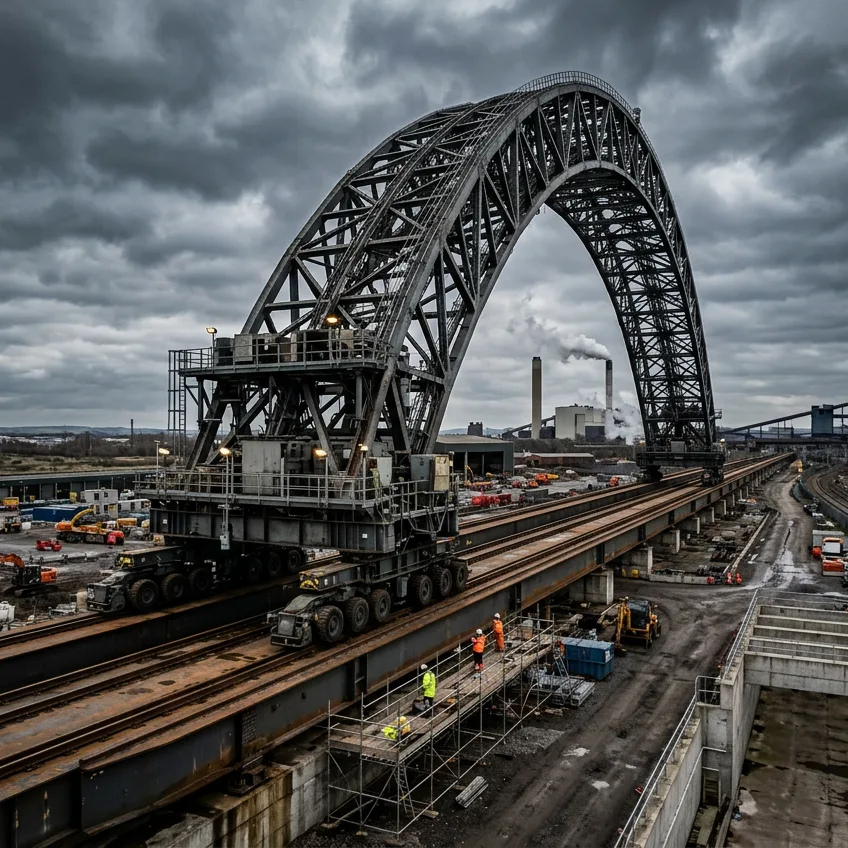
The major obstacle lay in the lethal radiation levels still emanating from the ruin: workers could not work directly above it. Therefore, the structure was assembled in an extensively decontaminated area more than 300 meters away. Measuring 108 meters in height, 162 meters in length, and with a span of 257 meters, the gigantic steel arch surpassed the height of the Statue of Liberty and weighed over 36,000 tons, tripling the weight of the Eiffel Tower.
The final phase took place in November 2016. To move such a mass, special rails lined with Teflon pads were installed. A sophisticated system of 224 hydraulic jacks pushed the arch centimeter by centimeter at an average speed of barely 10 meters per hour. Over several days, the megastructure slid smoothly over 327 meters until it fit millimeter-perfect over the damaged reactor.
Designed to withstand F3 tornadoes and magnitude 6 earthquakes, the interior of the arch is pressurized to prevent leaks and features robotic crane bridges to remotely dismantle the reactor over the next century.
Source: European Bank for Reconstruction and Development (EBRD) - Chernobyl New Safe Confinement Project