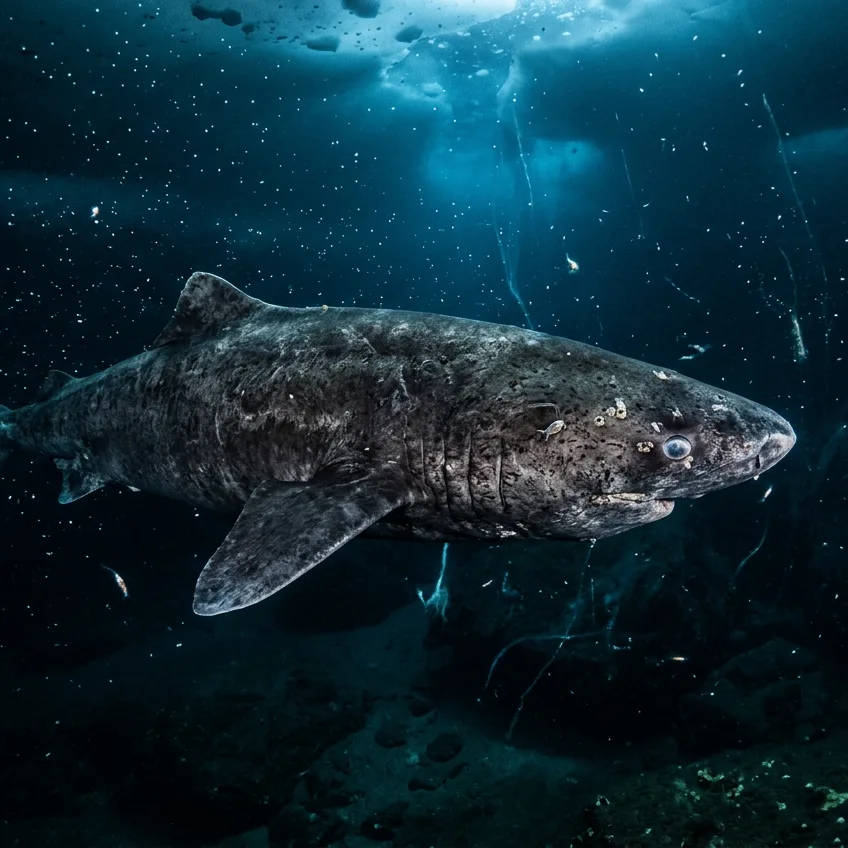
In the frigid depths of the Arctic Ocean lives the Greenland shark (Somniosus microcephalus), the longest-living vertebrate on our planet. While most animals measure their lives in five-year spans or decades, this giant shark does so in centuries: radiocarbon dating of the crystalline proteins in its eye lenses estimates that they can reach between 272 and over 400 years of age.
One of the most extraordinary discoveries, revealed in 2016 by researchers from the University of Copenhagen, is its reproductive pace. To reproduce, females must exceed four meters in length, a size they reach only after growing at a tiny rate of barely one centimeter per year. As a result, these animals do not reach sexual maturity until they are approximately 150 years old.
The secret to this immense longevity lies in an extreme metabolic slowdown adapted to waters near zero degrees:
- Ultra-slow heartbeat: Its heart can take up to twelve seconds to beat just once.
- Parsimonious movement: It travels at an average speed of 1.2 kilometers per hour, saving every last calorie.
- Protected tissues: Its flesh contains high concentrations of trimethylamine N-oxide, a compound that prevents freezing and cellular collapse under intense abyssal pressure.
An individual alive today could have roamed northern seas while Galileo pointed his telescope at the stars, turning this stealthy predator into a genuine biological time capsule.
Source: Science (Nielsen et al., 2016: 'Eye lens radiocarbon reveals longevity of the Greenland shark')