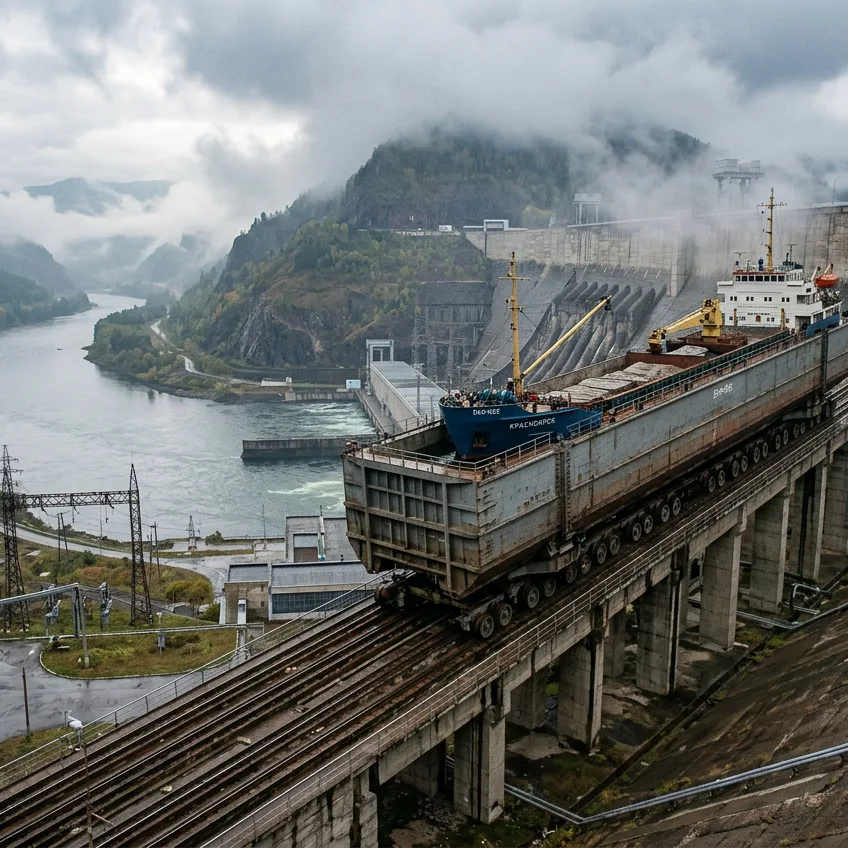
In the heart of Siberia, the massive Krasnoyarsk hydroelectric dam blocks the powerful Yenisei River with a 124-meter-high concrete wall. To avoid cutting off river traffic between the Arctic Ocean and the continental interior, Soviet engineers rejected traditional stepped locks—which would have consumed unfeasible volumes of water and time in freezing winters—and built one of the most extreme machines on the planet: a railway funicular for ships completed in 1982.
The core of the system is a gigantic 90-meter-long mobile steel chamber that functions like a bathtub on wheels. A ship sails into it, the gates seal tightly, and the entire unit—reaching 8,100 tons including the vessel and supporting water—begins to climb the rocky slope.
This mechanical mass operates through unprecedented technical milestones in the history of public works:
- The widest track gauge in the world: Its rails are 9,000 millimeters apart (exactly nine meters), more than six times the width of a standard international railway track.
- Rack-and-pinion drive: Hundreds of hydraulic motors drive toothed pinions that mesh with solid steel racks fixed to the ramp to prevent any catastrophic slippage.
- Summit turntable: Upon reaching the crest of the dam, the entire vehicle enters a circular concrete turntable that rotates to align it with the opposite slope and descend into the upper reservoir.
On a ninety-minute journey, this feat of electromechanical engineering transports merchant vessels along one and a half kilometers of steep slopes, turning heavy ships into extraordinary passengers on a mountain railway.
Source: International Commission on Large Dams (ICOLD)