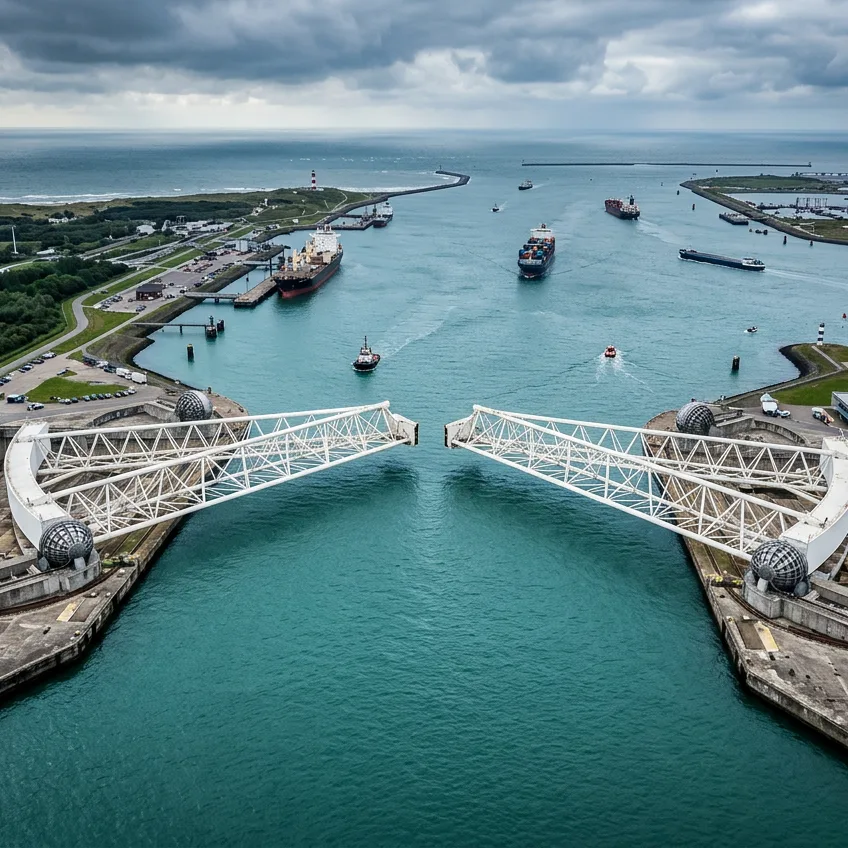
At the mouth of the Nieuwe Waterweg canal, which connects the massive Port of Rotterdam to the North Sea, lies one of the most astonishing mechanical and civil engineering works on the planet: the Maeslant Barrier (Maeslantkering). Inaugurated in 1997 as the final major piece of the Delta Works, its mission sounds like a structural fantasy: to close a 360-meter-wide navigable canal against storm surges without hindering daily maritime traffic.
To achieve this, engineers ruled out fixed dams and designed two arc-shaped mobile gates. Each leaf is supported by a steel truss beam 237 meters long, a structural mass comparable to laying down two full Eiffel Towers horizontally. What is truly unusual is the system that articulates this colossal weight:
- Titanic ball joints: Each arm pivots on a spherical joint 10 meters in diameter and weighing 680 tons, manufactured with millimeter-level casting tolerances to allow simultaneous horizontal and vertical rotation.
- Reverse Archimedes' principle: In the resting position, the gates sit in dry docks on both sides of the shore. When the alert is triggered, the docks flood and the enormous hollow steel boxes float on the water, being drawn toward the center of the river by diesel engines.
- Controlled sinking: Once aligned in the middle of the canal, valves flood their ballast tanks and the gates submerge 17 meters until they settle on a reinforced concrete bed on the seabed.
To avoid delays caused by panic or political hesitation during a catastrophe, the barrier is governed by a fully autonomous computer system that monitors sea levels; if the storm surge exceeds three meters above normal levels, the computer executes the maneuver without requiring human intervention.
Source: Rijkswaterstaat (Ministry of Infrastructure and Water Management of the Netherlands)