In northern Tanzania, overlooking the plains of the Great Rift Valley, rises Ol Doinyo Lengai, named by the Maasai people as the "Mountain of God." This colossus is not only a sacred site, but also the only active volcano on the planet that erupts natrocarbonatite, a chemically unusual type of magma that defies the classic image of terrestrial eruptions.
Unlike silica-rich lavas that reach between 1,000 °C and 1,200 °C, the magma of Ol Doinyo Lengai erupts at only 510 °C to 600 °C. By geological standards, this is an astonishingly cold temperature. The absence of silicate chains gives it an extremely low viscosity: instead of sliding as a dense, incandescent paste, it flows down the slopes with the speed and consistency of motor oil or liquid water.
Its visual and mineralogical behavior is completely unique:
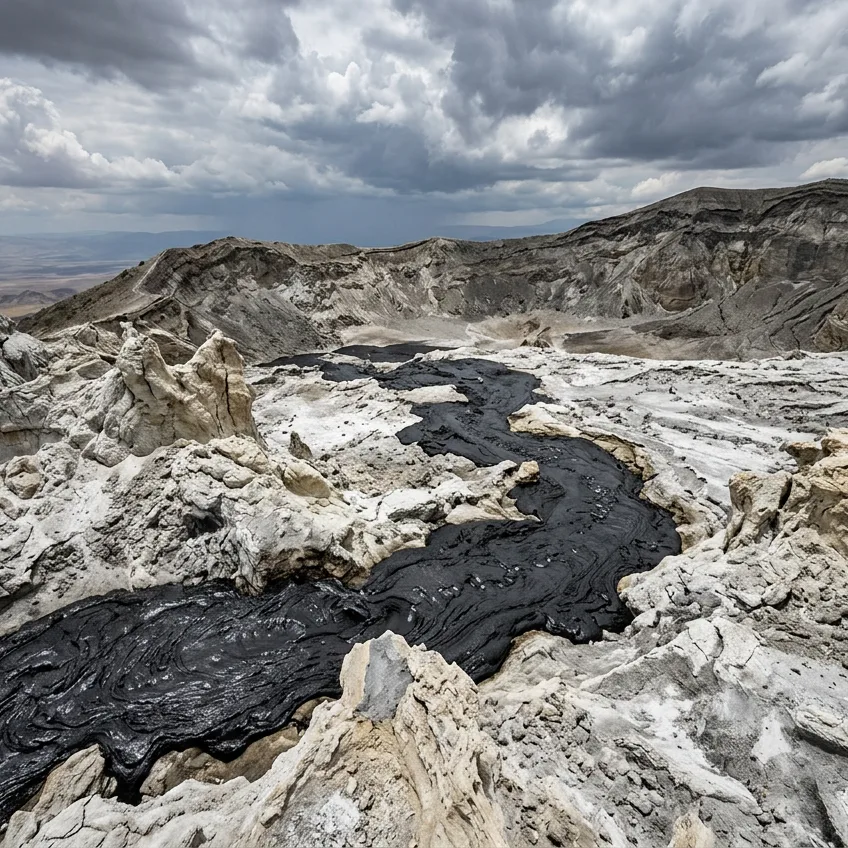
- By day, the lava emerges as a jet-black or dark brown stream, lacking the fiery glow common to other volcanoes.
- At night, it casts only a faint, ghostly reddish glow visible in complete darkness.
- In contact with the atmosphere, its minerals (rich in sodium, potassium, and calcium) absorb ambient moisture and oxidize rapidly, turning completely white within hours.
The result is a volcanic summit that looks permanently dusted with fresh snow in the heart of East Africa, offering science a unique window into the primordial chemistry of Earth's mantle.
Source: Smithsonian Institution - Global Volcanism Program