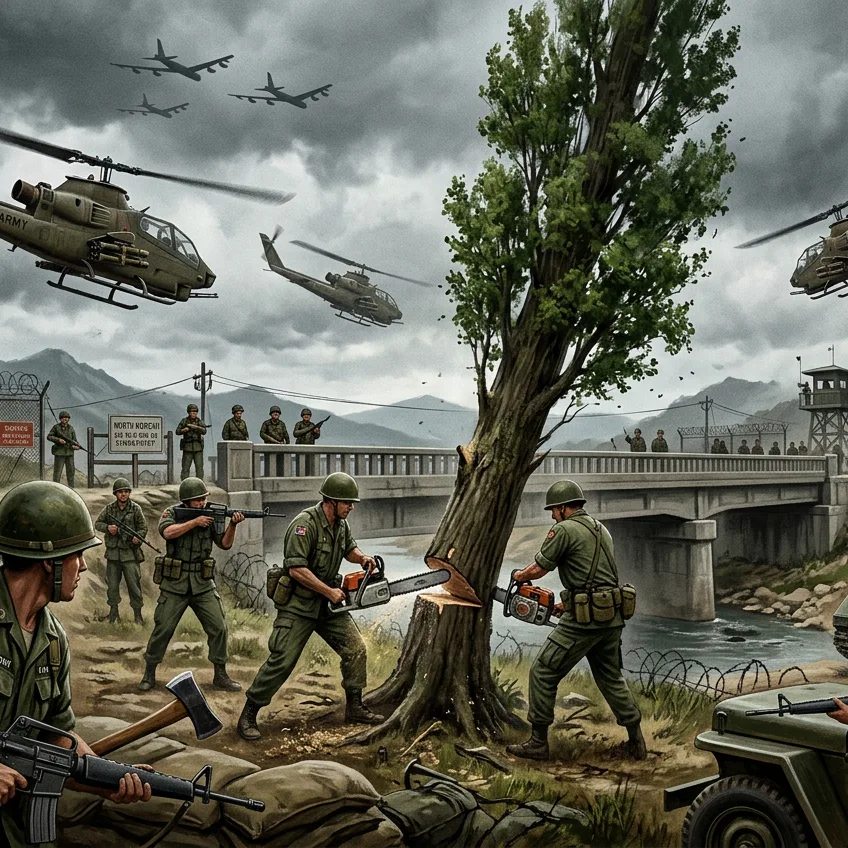
On August 21, 1976, the Demilitarized Zone between the two Koreas was the scene of one of the most disproportionate military operations in modern history: Operation Paul Bunyan. Three days earlier, two U.S. Army officers had been killed by North Korean soldiers while attempting to trim a twelve-meter-tall poplar tree that blocked the critical line of sight between two United Nations observation posts. The response from Washington and Seoul was not a declaration of war, but a demonstration of force so overwhelming that it left the world stunned.
At 07:00 in the morning, a convoy of military engineers entered the neutral zone escorted by an overwhelming military deployment:
- Ground forces: More than 800 soldiers armed to the teeth, including 64 South Korean special forces members trained in hand-to-hand combat and equipped with grenades and rifles.
- Immediate air escort: Twenty UH-1 utility helicopters and seven AH-1 Cobra attack helicopters flying at low altitude right over the border line.
- Strategic deterrent power: Squadrons of F-4 Phantom and F-111 fighters, supported by three massive nuclear-capable B-52 Stratofortress bombers patrolling in visible formation over Korean skies.
- Naval support: In adjacent waters, the aircraft carrier USS Midway and its entire battle group were positioned a short distance offshore.
Faced with this staggering war machine, the nearly 150 North Korean soldiers stationed nearby chose not to intervene and watched in stunned silence. In exactly 42 minutes, the engineers cut down the tree with chainsaws, leaving only a six-meter stump as a lasting warning, before withdrawing without a single shot being fired.
Source: U.S. Army Center of Military History / The National Security Archive (The DMZ 'Axe Murder Incident' and Operation Paul Bunyan)