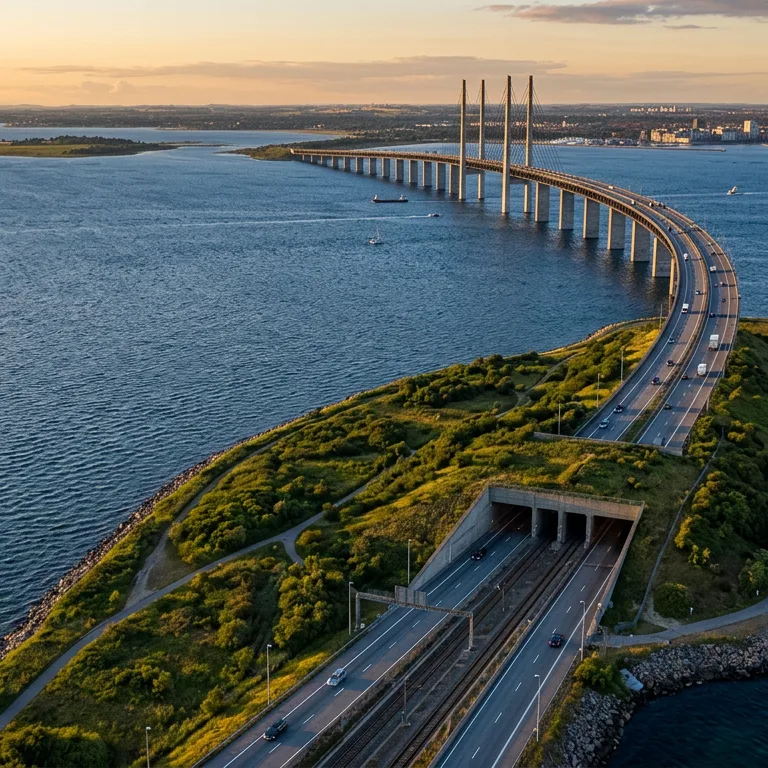
At the end of the 20th century, linking Copenhagen (Denmark) and Malmö (Sweden) by road and rail presented a seemingly unsolvable engineering puzzle. Designing a continuous bridge along the 16 kilometers of the strait was unfeasible: its enormous pillars and cable stays would have encroached on the approach zone of nearby Kastrup International Airport and obstructed the heavy maritime traffic of the Drogden Channel. However, digging a tunnel along the entire seabed multiplied costs and technical risks astronomically.
The bold response from engineers was to devise an unprecedented hybrid system: a colossal 7.8-kilometer cable-stayed bridge that, in the open sea, dives underwater via an immersed tunnel. To make the transition between air and sea possible, they built a four-kilometer-long artificial island from scratch, named Peberholm ("Pepper Islet").
To build Peberholm, more than 1.6 million cubic meters of rock and six million cubic meters of sand were dredged from the seabed. Across its artificial ridge, the railway tracks and four asphalt lanes descend toward the longest immersed concrete tunnel on the planet, assembled from 20 colossal prefabricated segments weighing 55,000 tons each, fitted together underwater with millimeter precision.
Inaugurated in 2000, the project did not just solve intercontinental transit: authorities banned the introduction of any seeds onto Peberholm. Today, the rubble platform is a strict biological reserve spontaneously colonized by hundreds of plant species and protected birds that nest unaware of the subterranean traffic.
Source: Øresundsbroen Konsortiet / Institution of Civil Engineers (ICE)