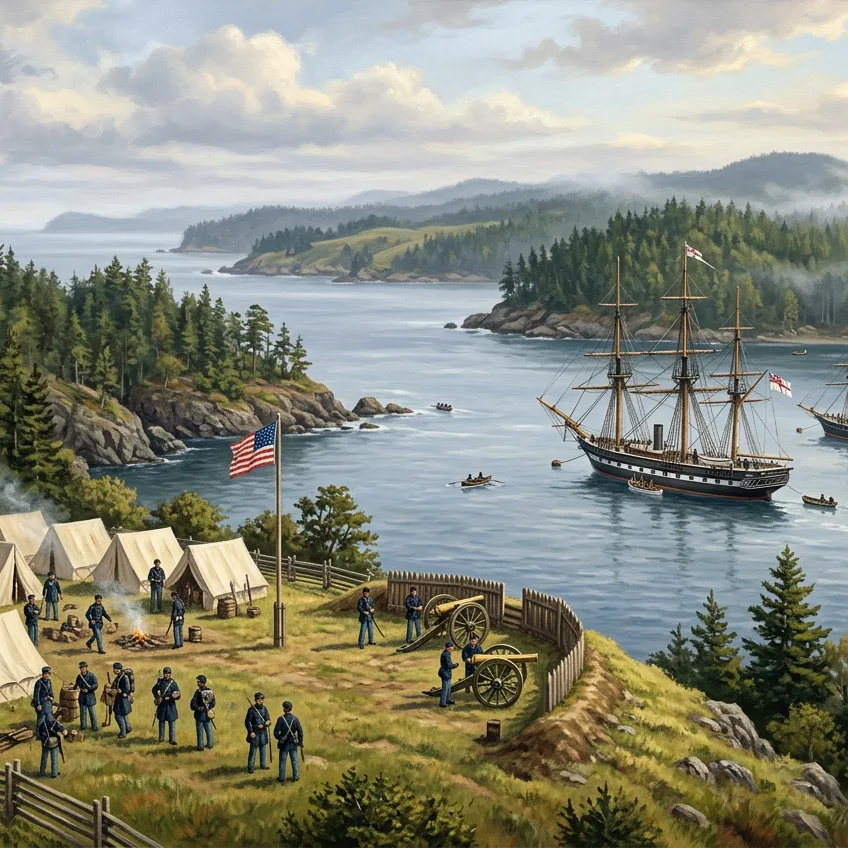
In June 1859, geopolitical tension between the United States and the British Empire nearly led to open war due to a domestic incident. The epicenter of the conflict was San Juan Island, a disputed territory between the U.S. Washington Territory and the British Colony of Vancouver Island.
The trigger occurred when Lyman Cutlar, an American settler, discovered a Berkshire pig devouring potatoes in his garden. Angered after several similar incidents, Cutlar shot and killed the animal. However, the pig belonged to Charles Griffin, a British employee of the influential Hudson's Bay Company. When British authorities threatened to arrest the farmer, American settlers requested urgent military protection.
The response was disproportionate. Brigadier General William S. Harney dispatched a company of 66 soldiers under the command of Captain George Pickett. In response, British colonial governor James Douglas dispatched three warships armed with dozens of cannons. By August 1859, the situation had escalated surrealistically: more than 400 American soldiers entrenched in earthen redoubts faced five British warships equipped with 70 cannons and more than 2,000 men on board.
Despite initial orders to respond to any provocation, British Admiral Robert L. Baynes refused to open fire, stating that he would not "involve two great nations in a war over a dispute about a pig". It took weeks for the news to reach Washington and London, where both governments reacted with bewilderment and agreed to a peaceful joint military occupation that lasted twelve years, finally resolved in 1872 through the arbitration of Kaiser Wilhelm I of Germany.
Source: National Park Service (San Juan Island National Historical Park) / The Pig War: Standoff at Griffin Bay (Mike Vouri)