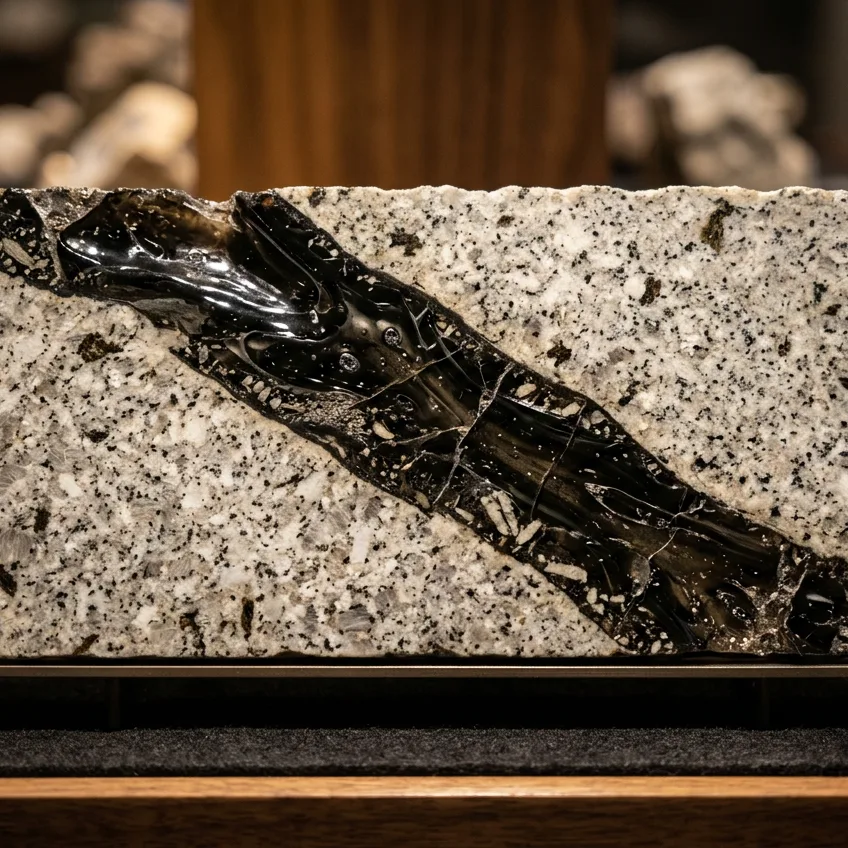
When we think of the origin of natural glass, we often picture volcanic obsidian or a lightning strike forging fulgurites in sand. However, deep within Earth's crust lies a far more violent phenomenon: pseudotachylytes, known among geologists as "fossilized earthquakes."
During a high-magnitude earthquake, two tectonic blocks do not slide smoothly; they grind and collide under crushing pressure at speeds exceeding 1 meter per second. In a matter of milliseconds, brutal friction concentrates immense heat that easily surpasses 1,100 °C across a millimeter-thin strip. The temperature rises so fast that it exceeds the melting point of surrounding minerals, turning solid rock into a thin film of liquid magma.
What is truly extraordinary happens just seconds later: as soon as the slip stops, the immense mass of adjacent cold rock thermally absorbs the melt almost instantly. Lacking the time to organize a crystalline structure, this liquid quenches abruptly and solidifies into dark pure glass that welds the very fracture that created it.
- Seismic energy calculation: The thickness and composition of these veins make it possible to calculate the exact power released by faults extinct for hundreds of millions of years.
- Cosmic impact markers: They also form following colossal meteorite strikes, most notably the massive veins discovered in the Vredefort impact structure in South Africa.
Thanks to pseudotachylytes, science can touch and analyze the exact pulse of an ancient earthquake, frozen forever in a glassy scar.
Source: Journal of Structural Geology