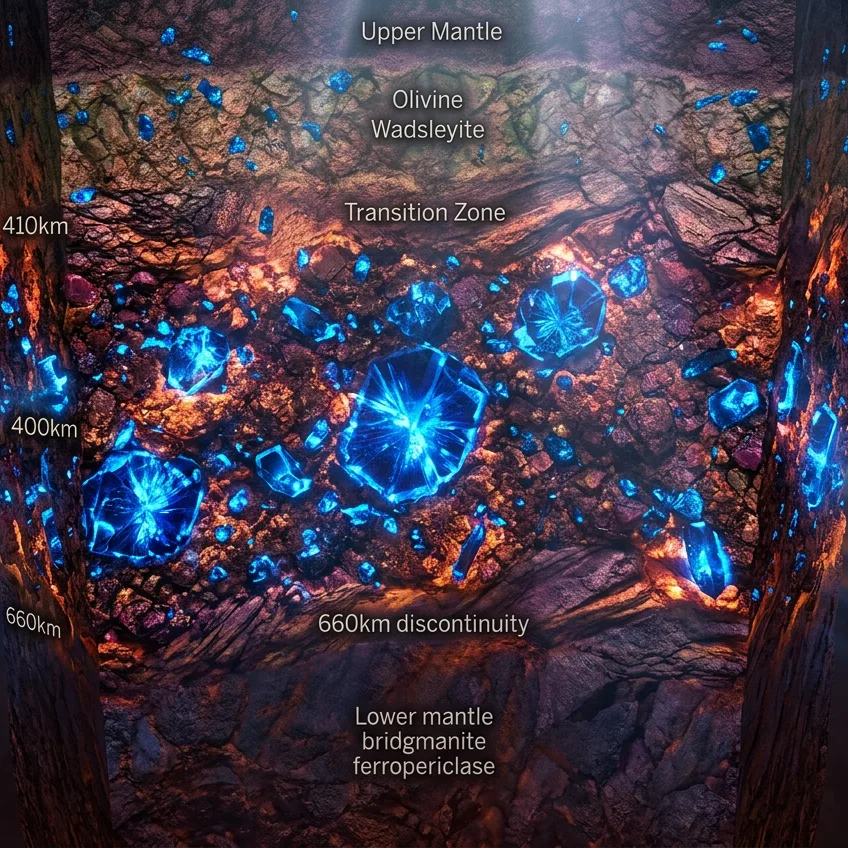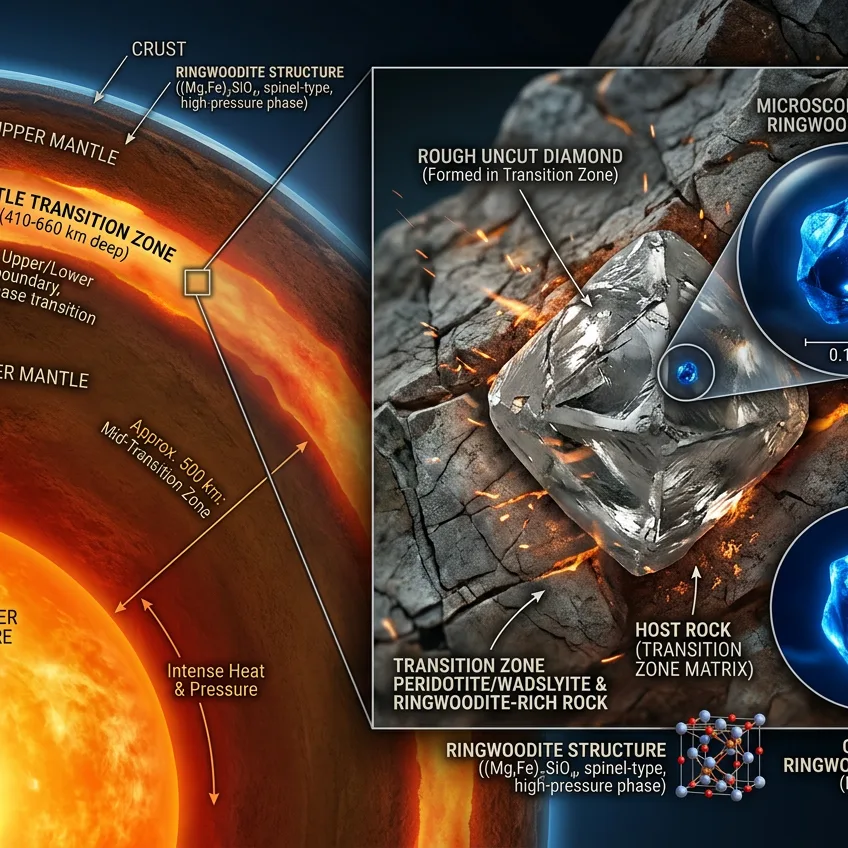
For decades, geologists debated whether the so-called Earth mantle transition zone—a belt located between 410 and 660 kilometers beneath our feet—was a dry environment or a colossal reservoir of fluids. The definitive answer arrived in 2014 thanks to a chance discovery in Juína, Brazil: an imperfect diamond, barely three millimeters across and of little commercial value, that held inside a microscopic inclusion of ringwoodite.
Ringwoodite is an ultra-high-pressure phase of olivine capable of existing only under extreme forces. Although it had been synthesized in laboratories and observed in meteorite fragments, an intact natural sample from Earth's mantle had never been documented, as it usually degrades while ascending. Spectroscopic analysis by the team led by geochemist Graham Pearson revealed something astonishing: the mineral contained close to 1.5% of its weight in water trapped in the form of hydroxyl ions within its crystal lattice.
That seemingly modest percentage takes on colossal proportions when multiplied across the volume of the transition zone: the deep mantle holds as much or more water than all surface oceans combined. Far from being a sci-fi underground lake, this molecular ocean is locked inside solid rock, where it acts as an essential geochemical lubricant to lower magma melting points and facilitate the mantle convection driving plate tectonics.
Source: Nature (Pearson et al., 'Hydrous mantle transition zone indicated by ringwoodite included within diamond', 2014)