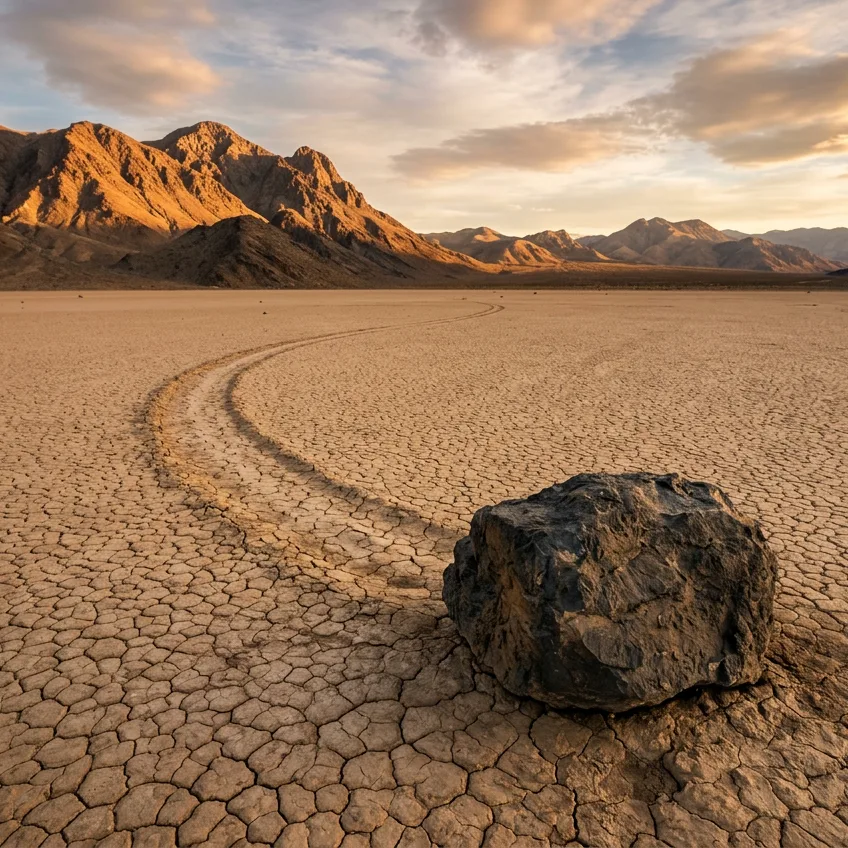
For more than half a century, a dry lake bed in Death Valley National Park, known as Racetrack Playa, baffled geologists worldwide. Hundreds of dolomite rocks, some weighing up to 320 kilograms, left long straight and winding trails carved into the hardened mud, proving movements of hundreds of meters with no human or animal footprints nearby.
Wild hypotheses were proposed, ranging from gravitational anomalies and magnetic fields to hurricane-force wind vortices. However, in 2014, a team led by oceanographer Richard Norris unveiled the exact mechanism thanks to a precision weather station and stones equipped with GPS receivers:
- The water trap: In rare winters, scarce rainfall floods the basin, forming a shallow surface layer just a few centimeters deep.
- Windowpane ice: During freezing nights, the water freezes, creating sheets of translucent ice as thin as window glass (between 3 and 6 millimeters thick).
- The wind-driven raft: When the sun rises, the ice breaks into gigantic floating panels. With gentle winds of just 15 km/h, these massive ice rafts slowly push the rocks across the softened mud bed, moving them at almost imperceptible speeds of a few centimeters per second.
This phenomenon requires a perfect and extremely rare conjunction of cold, liquid water, thin ice formation, and morning wind, allowing massive stones to sail across one of the driest surfaces on Earth.
Source: PLOS ONE (Norris et al., 2014 - 'Sliding Rocks on Racetrack Playa, Death Valley National Park: First Observation of Rocks in Motion')