At the beginning of the 19th century, smallpox was one of the most devastating plagues on the planet, capable of taking millions of human lives. Although Edward Jenner had discovered that inoculating the cowpox virus conferred immunity against the deadly disease, a monumental technical obstacle existed: how to transport such a sensitive biological substance across the Atlantic before the invention of artificial refrigeration?
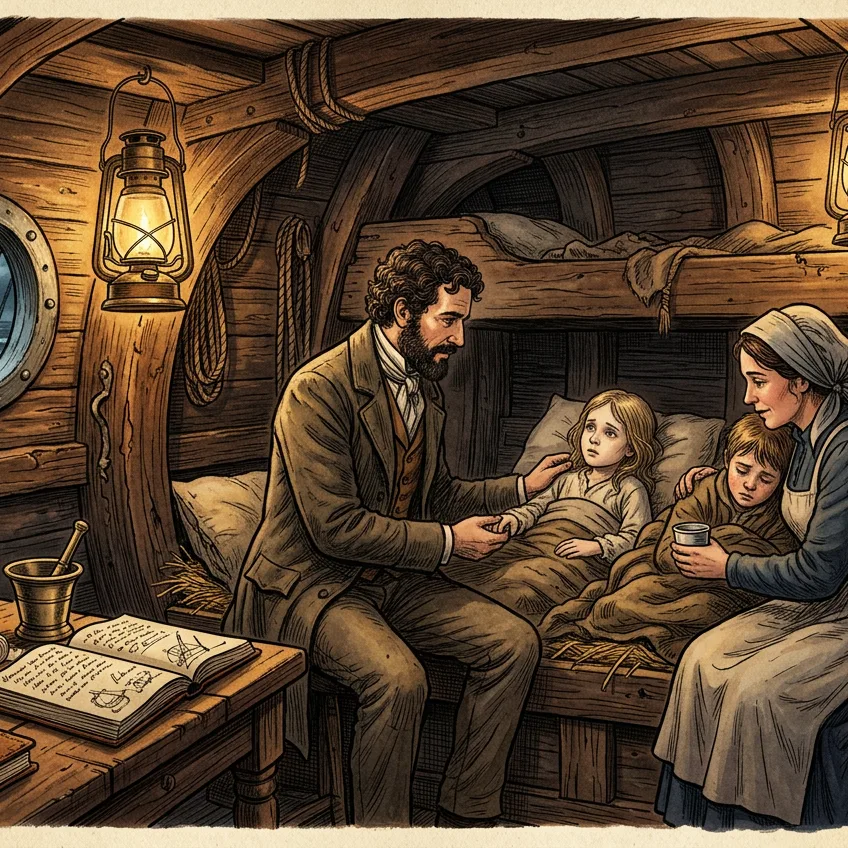
In 1803, the Spanish physician Francisco Javier Balmis proposed a solution as bold as it was unprecedented. He set sail from the port of La Coruña on the corvette María Pita with twenty-two orphan children from Galician foundling homes, aged between three and nine years old, under the care of Isabel Zendal, the rector of the orphanage. Since liquid samples in glass vials spoiled in the tropical heat, Balmis used the children as a living biological transmission chain. Every nine or ten days, he inoculated two healthy children with the active fluid from the pustules of the previous pair, preserving the benign virus fresh and viable during months of uninterrupted navigation.
Known as the Royal Philanthropic Vaccine Expedition, it became the first global healthcare campaign in history. After crossing the Atlantic, the mission traveled through Mexico, Central America, South America, and the Caribbean, subsequently extending across the Pacific Ocean to the Philippine Islands and the coasts of China. Those abandoned little ones, whose names remained anonymous for decades, served as a living vehicle to immunize hundreds of thousands of people and establish public vaccination boards across four continents.
Source: Archivo General de Indias and Real Academia Nacional de Medicina de España