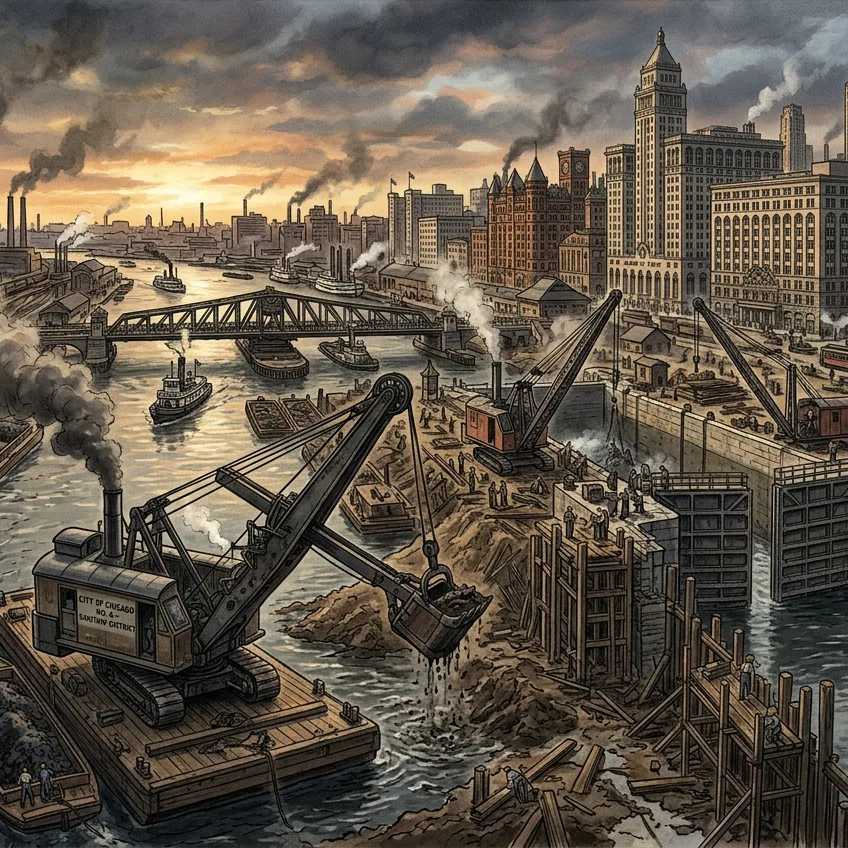
At the end of the 19th century, the city of Chicago was growing at a dizzying pace, but it faced an unprecedented health crisis. Its entire urban network dumped tons of sewage and industrial waste directly into the Chicago River, which naturally flowed into vast Lake Michigan. The serious dilemma was that the lake was also the sole source of drinking water for the metropolis, which triggered lethal outbreaks of typhoid fever and cholera.
The solution proposed in the 1890s was not to treat the wastewater, but to carry out one of the greatest topographical modifications in human history: reversing the course of a navigable river. To achieve this, engineers designed the Chicago Sanitary and Ship Canal, a monumental 45-kilometer-long trench excavated through strata of limestone and clay.
The project required moving more than 30 million cubic meters of earth and rock. By excavating the canal at an elevation lower than that of Lake Michigan, gravity completely reversed the current: lake waters began flowing into the Chicago River, carrying sewage toward the Des Plaines and Illinois rivers, ultimately integrating it into the Mississippi basin and keeping it permanently away from the city's drinking water intakes.
Inaugurated on January 2, 1900, this civil engineering milestone drastically reduced typhoid deaths and laid the mechanical and mass excavation foundations that enabled, years later, the construction of the Panama Canal.
Source: American Society of Civil Engineers (ASCE) - Chicago Sanitary and Ship Canal Landmark Historical Record