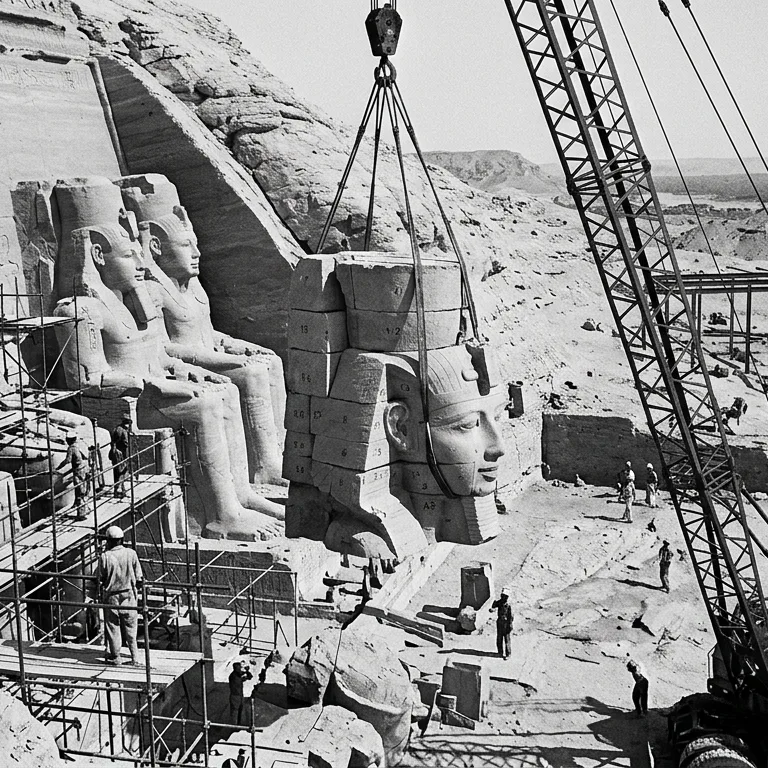
In the early 1960s, the construction of the Aswan High Dam threatened to submerge one of antiquity's greatest treasures forever under the waters of Lake Nasser: the temples of Abu Simbel, carved directly into sandstone rock during the reign of Ramesses II. Facing the imminent flood, an international consortium led by UNESCO and carried out by Swedish, German, Italian, and Egyptian engineers accomplished an unprecedented feat.
The technical challenge ruled out the use of explosives, as vibrations would have pulverized the fragile rock. Instead, workers used handsaws and steel cables to cut both temples with millimeter precision into 1,036 colossal blocks weighing up to 30 tons each. To prevent the stone from crumbling when lifted by heavy cranes, synthetic resins were injected and steel tension rods were installed in deep boreholes.
The temples were moved 65 meters higher and 200 meters inland. There, modern engineering delivered another hidden miracle: to recreate the look of the original mountain without crushing the inner sanctuaries under the weight of thousands of tons of rubble, engineers built a gigantic reinforced concrete dome spanning over 50 meters across each temple, camouflaged under natural rock. Thanks to rigorous astronomical calculations, the sun continues to illuminate the inner sanctuary twice a year, preserving a three-millennium-old marvel.
Source: UNESCO World Heritage Centre - The Rescue of Nubian Monuments and Sites