For more than six decades following its scientific description in 1939, the barreleye fish (Macropinna microstoma) remained a distorted biological mystery. Specimens caught by trawling reached the surface disfigured, until in 2004 researchers from the Monterey Bay Aquarium Research Institute (MBARI) managed to film it alive in its habitat: the mesopelagic zone, between 600 and 800 meters deep.
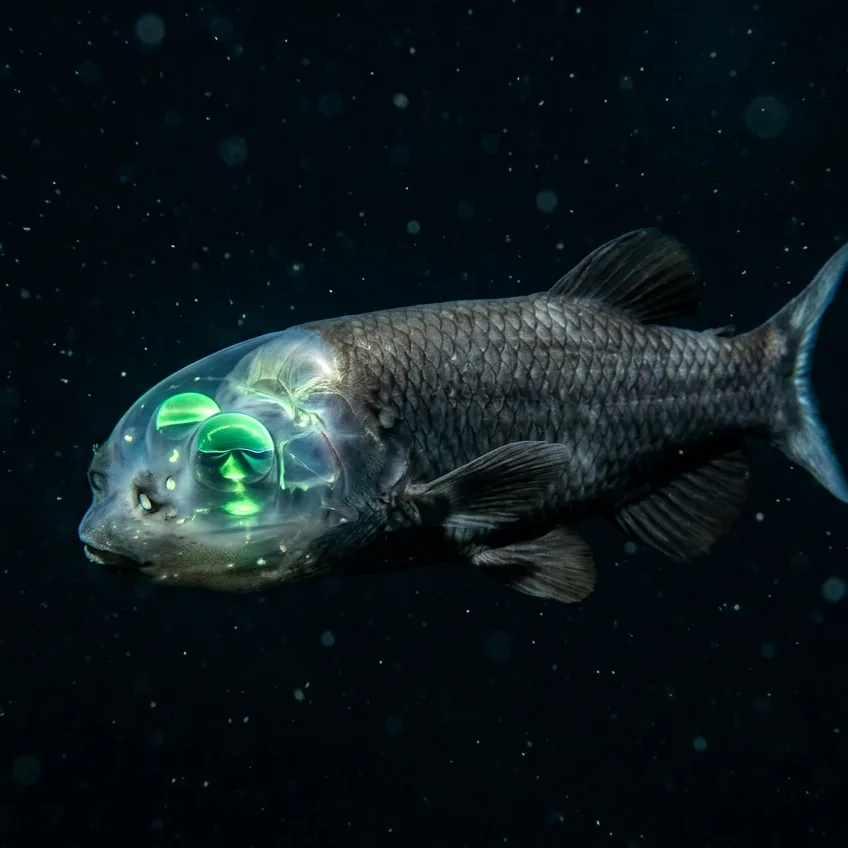
The footage revealed an unusual anatomy: the top of its head is covered by a transparent fluid-filled shield, resembling the cockpit of a fighter jet. What appear to be two eyes on the front of its face are actually olfactory organs called nares. Its real eyes are two large, emerald-green tubular cylinders located inside its skull.
This arrangement is an extreme evolutionary adaptation:
- Internal eye rotation: Its eyes can pivot within its head, switching from looking vertically upward to detect silhouettes to looking forward to guide its mouth when attacking.
- Green optical filters: The lenses contain special pigments that block faint downwelling sunlight, allowing it to distinguish the bioluminescence emitted by its preferred prey.
- Protective shield: The fluid dome protects its delicate visual organs from the stinging tentacles of siphonophores, from which it often steals trapped small crustaceans.
Motionless in the dark thanks to its broad stabilizing fins, this fish, barely fifteen centimeters long, remains suspended like a living underwater telescope, scanning the abyss through its own crystal anatomy.
Source: Monterey Bay Aquarium Research Institute (MBARI)