In the heart of Tanzania, right in the Great Rift Valley, stands Ol Doinyo Lengai, known by the Maasai as the "Mountain of God." Far from being a conventional volcano, it holds an absolute geochemical distinction: it is the only active volcano on Earth that erupts natrocarbonatite lavas, rich in sodium and potassium carbonates, instead of the usual silicates that make up more than 99% of terrestrial volcanism.
This unique mineral composition gives rise to phenomena that baffle geologists:
- An astonishingly low temperature: While basalts emerge at temperatures between 1,000 °C and 1,200 °C, the lava of Ol Doinyo Lengai erupts at just 500 °C or 600 °C, making it the coldest active lava on the planet.
- Extreme fluidity: Practically lacking silica (the component that gives viscosity to common magma), its molecular bonds are very weak. As a result, the lava moves at high speed with the consistency of water or thick oil.
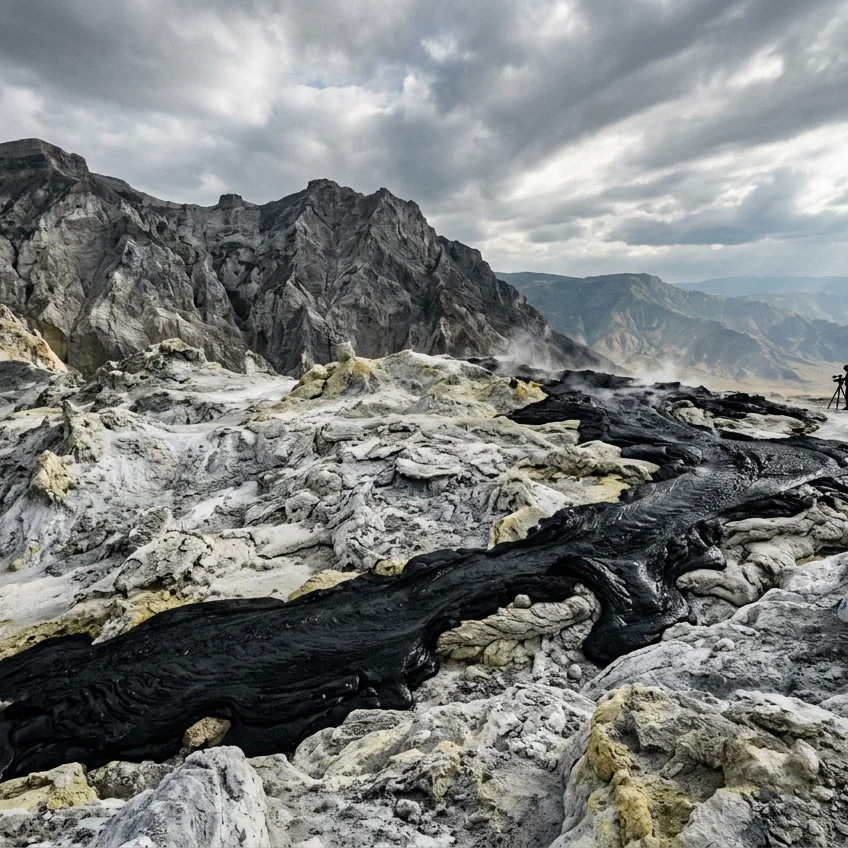
- Instant chemical camouflage: During the day, the lava emerges jet black, similar to fresh tar, with a faint, almost imperceptible reddish glow. However, in just a few hours, unstable minerals such as nyerereite and gregoryite react with atmospheric moisture, bleaching the flow until it transforms into a snowy blanket that mimics snow under the African heat.
For geological science, this volcano is a truly unique natural laboratory that offers a direct window into exotic magmas and chemical separation processes within the deep mantle.
Source: Nature Geoscience / Smithsonian Institution Global Volcanism Program