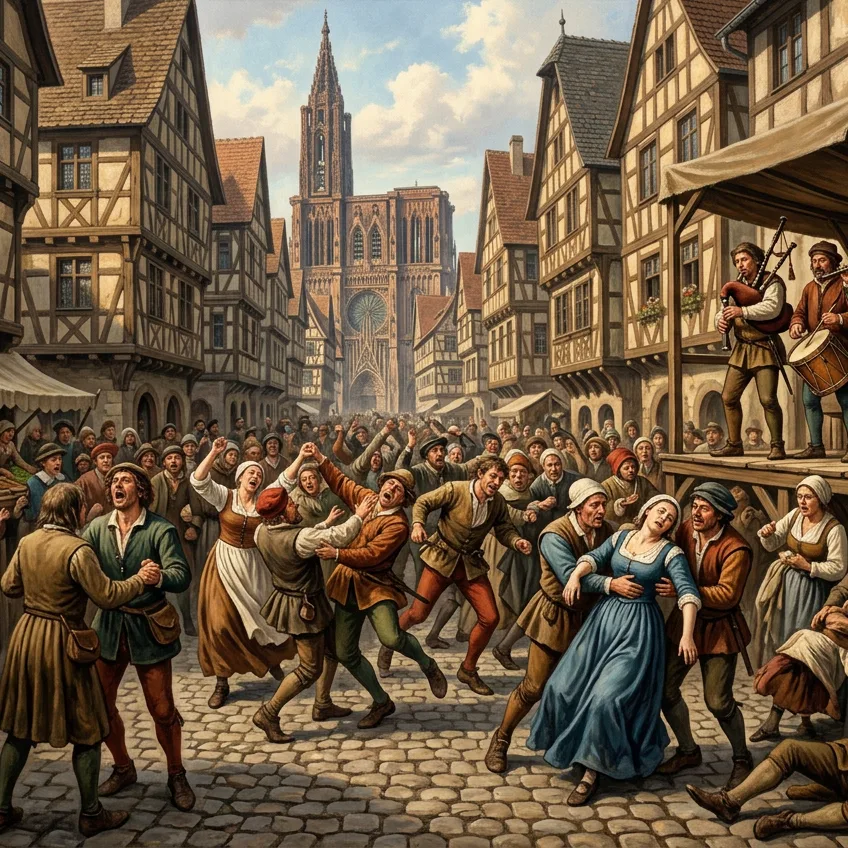
In the heart of the summer of 1518, a woman named Frau Troffea stepped onto a paved street in Strasbourg and began to dance frenetically. There was no music, no celebration, and no apparent reason; nevertheless, she could not stop for nearly six consecutive days. In less than a week, more than thirty people had joined her uninterrupted trance. By August, the dancing crowd exceeded four hundred individuals.
Baffled by the chaos, local authorities consulted the city's physicians. They ruled out supernatural causes and diagnosed a natural ailment caused by "overheated blood." The remedy prescribed by the municipal council proved fatal: they believed the only cure was to dance continuously until purging the affliction. Consequently, the city council hired professional musicians, pipers, and drummers, and even erected a wooden stage at the horse market to facilitate movement.
The measure accelerated the tragedy. Under sweltering heat, dozens of people collapsed from extreme exhaustion, dehydration, heart attacks, and strokes, with multiple deaths recorded daily. The survivors only managed to quell the frenzy after being transported to a shrine dedicated to Saint Vitus, where they were placed in consecrated shoes and given small lead crosses.
Today, medical historians classify the event as Europe's most extraordinary and documented case of mass psychogenic illness, triggered by years of devastating famine, syphilis epidemics, and widespread superstitious dread.
Source: Waller, J. (2008). 'A Time to Dance, a Time to Die: The Extraordinary Story of the Dancing Plague of 1518'. St. Martin's Press.