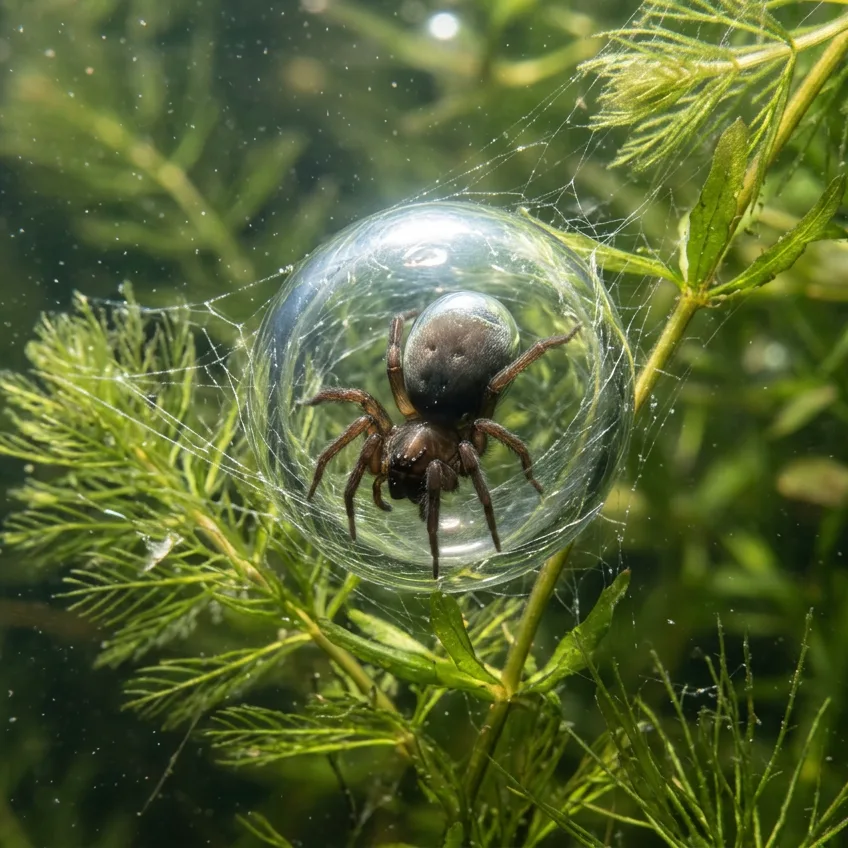
Among the more than 50,000 spider species cataloged on the planet, only one has managed to conquer the aquatic realm: the diving bell spider (Argyroneta aquatica). Although it retains book lungs designed exclusively to breathe atmospheric air, it spends virtually its entire existence submerged in freshwater ponds of Europe and Asia, where it hunts, mates, and hibernates thanks to a true bioengineering masterpiece: the diving bell.
To build its shelter, this spider rises to the surface and traps an air bubble between the hydrophobic hairs of its abdomen. It then submerges and releases the gas beneath a dense silk web attached to vegetation. It repeats this process until it inflates a silvery air chamber. However, its greatest biological secret lies in the physics of the dwelling:
- Passive gill effect: The silk membrane and the surface tension of the bubble allow gas exchange with the surrounding water. As the animal consumes oxygen, the partial pressure inside the bell drops, naturally drawing dissolved oxygen from the water into the interior.
- Over 24-hour autonomy: Researchers from the University of Adelaide discovered in 2011 that this continuous diffusion generates enough oxygen for the spider to remain submerged for an entire day without needing to surface for air.
The only limit to this biological submarine is the slow loss of nitrogen into the water, which eventually shrinks the bubble and forces the arachnid to make a quick trip to the surface to replenish it.
Source: The Journal of Experimental Biology (Seymour & Hetz, 2011)