When erecting the tallest structure ever built by human beings, the first major challenge was not in the sky, but underground. The soil of Dubai lacks a firm, accessible bedrock; beneath the surface there are only weak layers of calcareous sand, porous sandstone, and marine silt, soaked in groundwater with an extreme salinity capable of devouring steel.
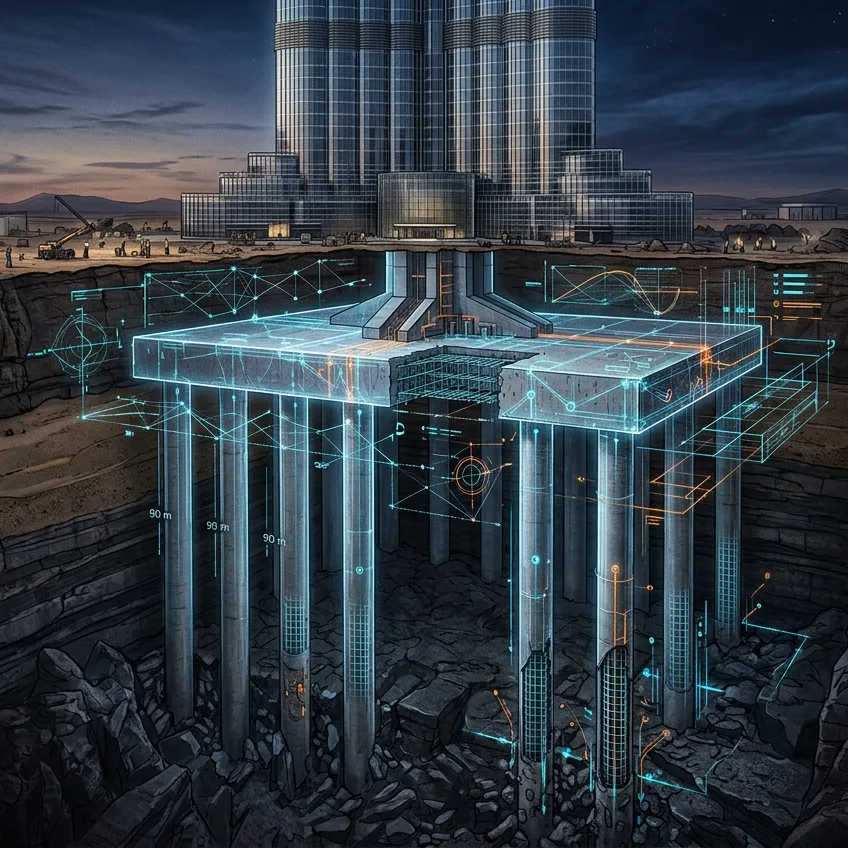
To prevent a giant of 500,000 tons and 828 meters from sinking or tilting under the strong desert winds, engineers turned to an elemental physical principle taken to an unprecedented scale: skin friction piling.
The base of the skyscraper works through two coordinated elements:
- A reinforced concrete raft: a massive block 3.7 meters thick and 12,500 cubic meters of high-density concrete poured in several phases.
- 192 colossal piles: cylinders 1.5 meters in diameter excavated to more than 50 meters deep. Because there is no hard rock at the bottom, the piles do not rest on a solid base; they remain in place due to the immense frictional force between the roughness of their walls and the surrounding soil.
To ensure that the structure survives for centuries in the hostile environment, a sophisticated cathodic protection system using impressed electric currents was installed, which prevents chloride ions from seawater from corroding the internal steel reinforcement. Thanks to this geotechnical miracle, the world's most imposing building floats with absolute stability on a cushion of friction in the desert.
Source: Baker, W. F., et al. (2008). 'Engineering the World's Tallest - Burj Dubai'. Council on Tall Buildings and Urban Habitat (CTBUH).