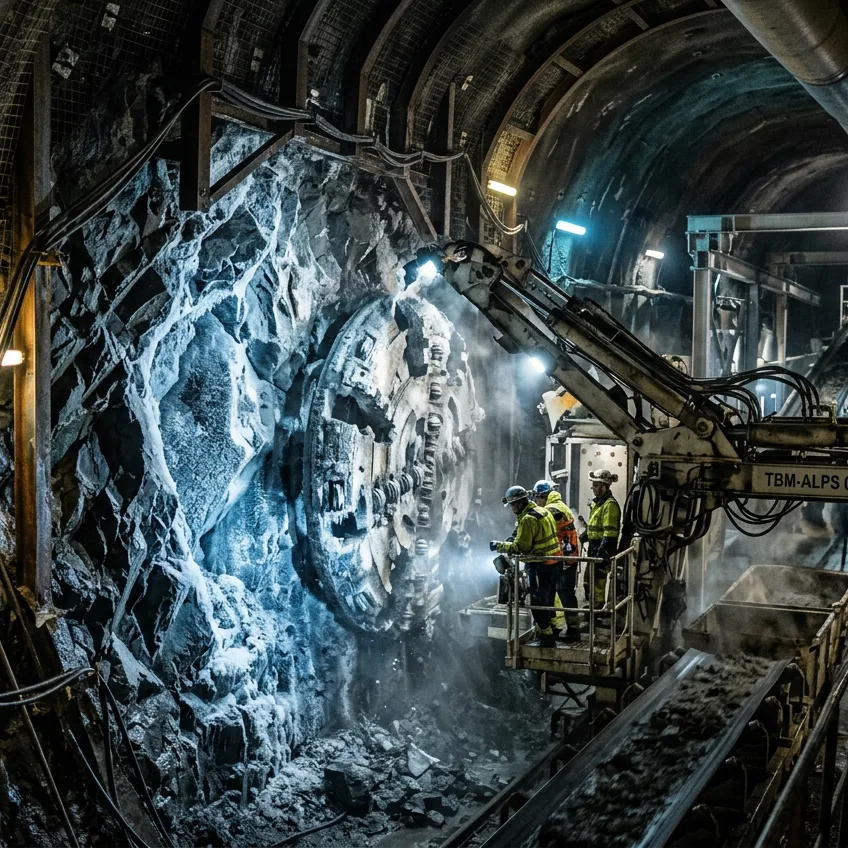
Excavating the Gotthard Base Tunnel in Switzerland, with a record length of 57 kilometers beneath the heart of the Alps, pitted engineers against one of the greatest structural challenges in history: the dreaded Piora Syncline. This geological formation was not made of solid rock, but rather pulverized dolomite mixed with water under extremely high pressure, a deadly consistency dubbed "sugar mud" that threatened to instantly collapse the construction works.
To cross this section without the mountain crashing down on the workers, engineers turned to an extreme technique: artificial ground freezing. Before introducing the tunnel boring machine or advancing with controlled explosions, hundreds of millimeter-precise holes were drilled and injected with calcium chloride brine at –30 °C, combined with liquid nitrogen at –196 °C to accelerate the process.
- The ice wall: The freezing fluid circulated in a closed circuit for months, drawing heat from the ground and freezing the interstitial water of the fault.
- Colossal strength: The fluid mud turned into a ring of artificial permafrost as hard as granite, capable of withstanding thousands of tons of tectonic pressure.
Under this protective ice shield nearly three meters thick, machinery was able to excavate and line the tunnel with high-density concrete before the ground thawed in a controlled manner. Inaugurated in 2016, Gotthard proved that thermal physics can tame the most relentless mountains.
Source: AlpTransit Gotthard AG / Swiss Federal Railways (SBB)