Excavating through the heart of a mountain range is one of the greatest technical challenges imaginable, but the Gotthard Base Tunnel in Switzerland took civil engineering to a new dimension. At 57.1 kilometers long, it holds the record as the longest and deepest rail tunnel on the planet, crossing the Alpine massif beneath up to 2,300 meters of solid rock.
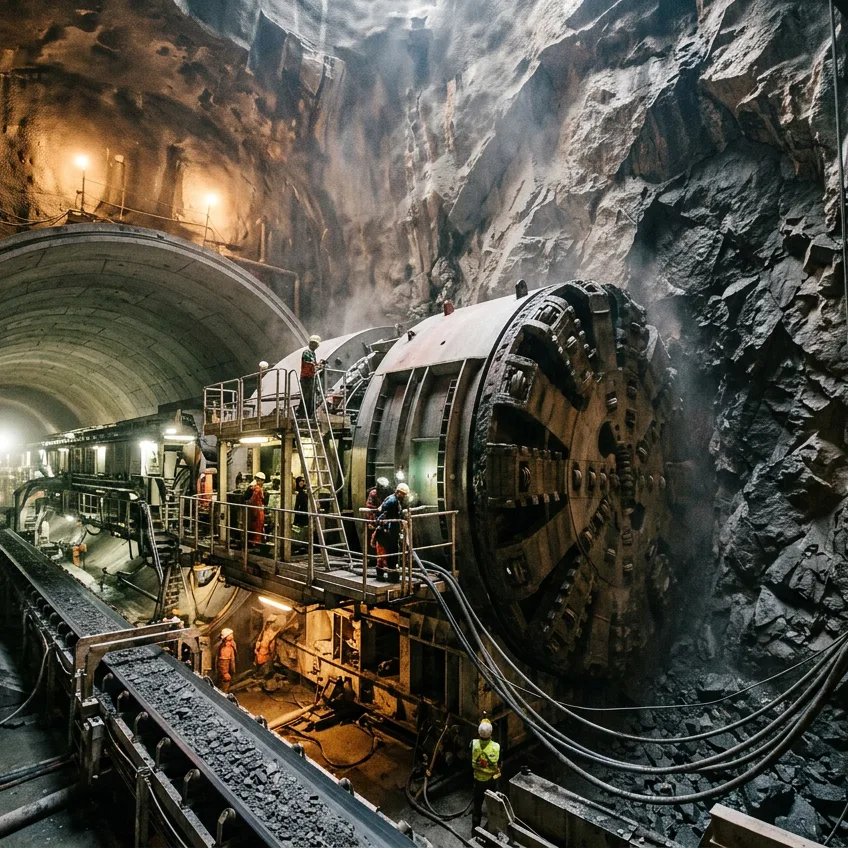
Construction, which formally began in 1999 after decades of planning, required drilling simultaneously from opposite ends. Four colossal tunnel boring machines (TBMs) measuring over 400 meters long and weighing 3,000 tons crushed 28.2 million tons of rock, a volume equivalent to several Pyramids of Giza. Deep inside the mountain, geothermal heat drove natural temperatures above 46 °C, forcing the installation of complex cooling systems and cold air ventilation to make human labor tolerable.
The culminating moment occurred on October 15, 2010. After advancing blindly for over a decade by combining surface GPS satellite geodesy, high-precision gyroscopes, and optical plummets in 800-meter vertical shafts, the drilling machine broke through the final rock wall between Sedrun and Faido. The result astonished the engineering community: across dozens of underground kilometers, the alignment error between both ends was barely 8 centimeters horizontally and 1 centimeter vertically.
Source: AlpTransit Gotthard AG / Swiss Federal Railways (SBB)