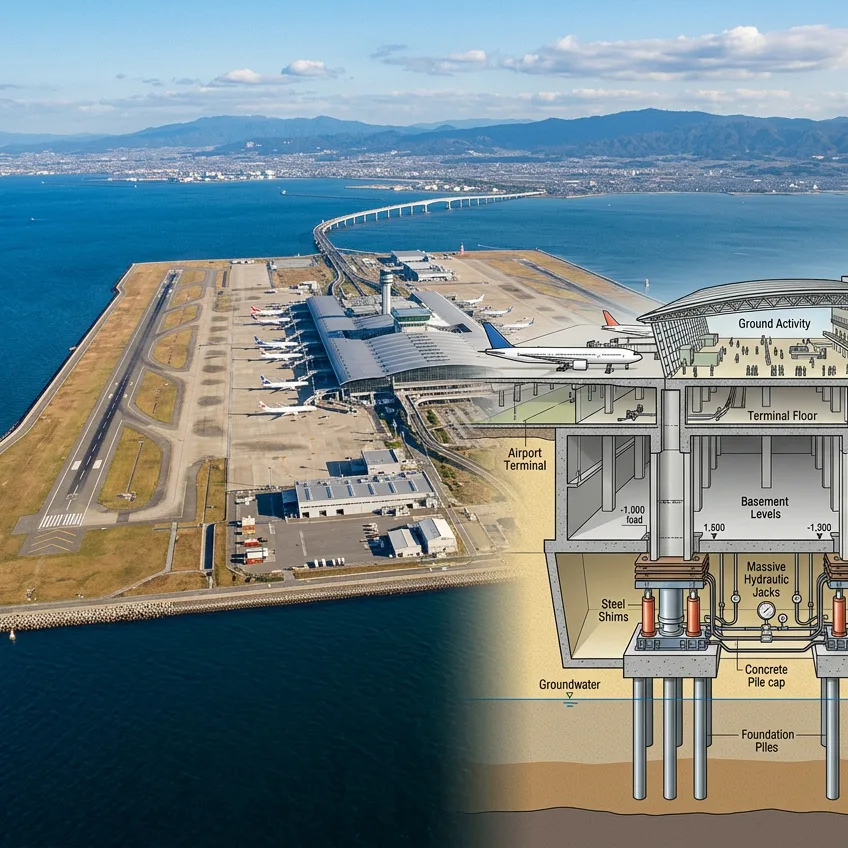
Inaugurated in 1994 in Osaka Bay, Kansai International Airport was one of the boldest civil engineering works of the 20th century: an entire airport complex built on an artificial island of more than 500 hectares. However, engineers faced an unforgiving enemy: the seabed, composed of strata of soft, unstable clay tens of meters thick. Although some settlement was calculated, the island began sinking at a much faster rate than anticipated, already exceeding eleven meters of total descent.
The greatest danger to the passenger terminal—a 1.7-kilometer-long giant designed by Renzo Piano—was not descending, but the dreaded differential settlement. If one section sank just a few centimeters more than the adjacent one, structural tensions would shatter glass panels and crack main beams. To prevent catastrophe, a pioneering solution was designed:
- Millimeter-precise monitoring: Computerized sensors and levels evaluate the tilt and elevation of each structural area day and night.
- 900 hydraulic jacks: The base of each of the nine hundred main columns of the terminal houses powerful hydraulic jacks capable of lifting hundreds of tons.
- Steel shims: When a column descends more than tolerated, the jack raises it millimeter by millimeter, and engineers insert ground steel plates to return the structure to its original level.
Thanks to this dynamic foundation system, the terminal continues to operate without deforming while the ground beneath its feet continues to yield to the ocean.
Source: American Society of Civil Engineers (ASCE) / Kansai Airports Engineering Technical Data