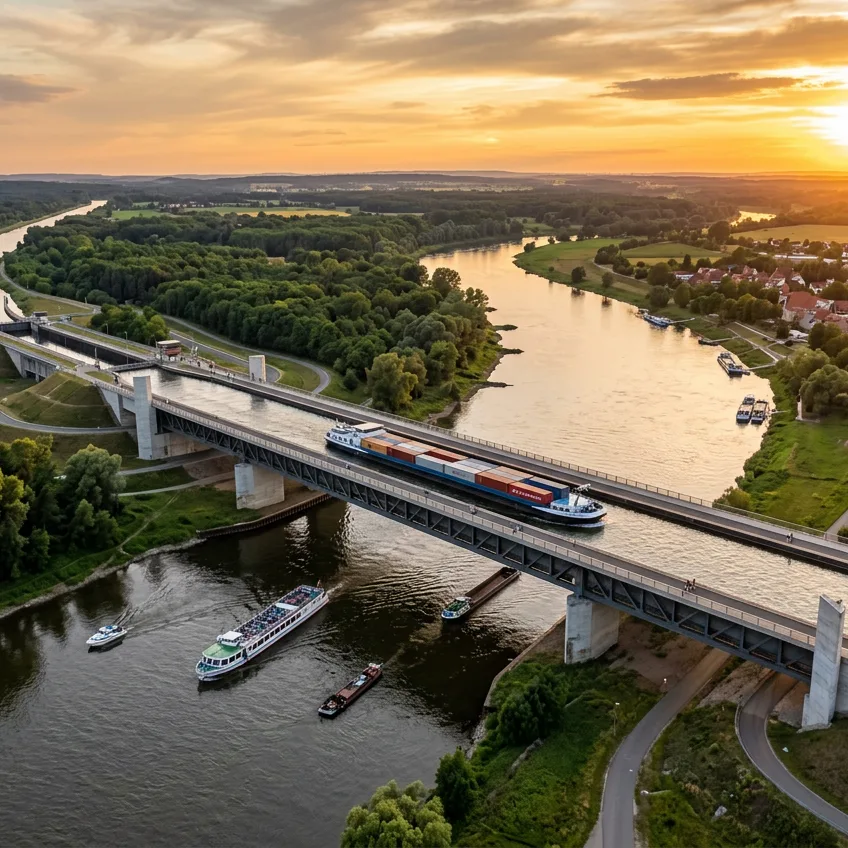
In central Germany, there is a scene that seems to defy visual logic: large cargo ships crossing a bridge suspended in the air, while other vessels sail calmly along the river flowing just below. This is the Magdeburg Water Bridge (Kanalbrücke Magdeburg), the longest navigable structure of its kind on the planet, with a total length of 918 meters.
Inaugurated in 2003 following an investment of around 500 million euros, this aqueduct connects the Elbe-Havel Canal with the Mittelland Canal. Before its opening, ships had to descend to the bed of the Elbe River through locks, navigate unpredictable low-water conditions, and climb back up—a twelve-kilometer detour that caused constant logistical bottlenecks. The earliest ideas to connect both waterways dated back to 1905, and construction began in the 1930s, but work remained paralyzed for over half a century due to World War II and the subsequent division of Germany during the Cold War.
To support this artificial watercourse, engineers used 24,000 tons of steel and 68,000 cubic meters of reinforced concrete, designed to house a 4.25-meter-deep trough that constantly holds tens of thousands of tons of water. The structure also embodies a curious physical principle: thanks to Archimedes' principle, the weight borne by the bridge does not increase when a giant cargo ship enters, as the vessel displaces an exact volume of water equivalent to its own mass, keeping the structural load perfectly unchanged.
Source: Wasserstraßen- und Schifffahrtsamt Magdeburg (WSA) / Structurae