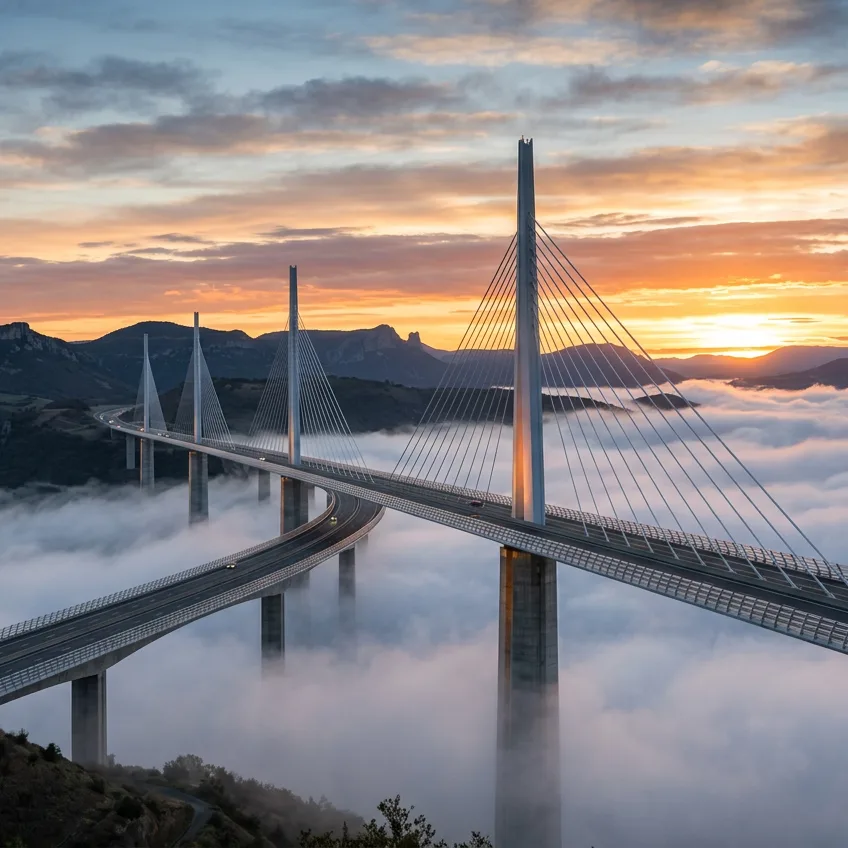
Inaugurated in 2004 in southern France, the Millau Viaduct holds the record for the structure with the tallest pier on the planet. Its most imposing central pier, P2, reaches 343 meters in height, surpassing the iconic Eiffel Tower. However, the most daunting challenge for engineers was not only laying the foundations for such concrete masses in the steep Tarn River valley, but placing a metal highway 2,460 meters long and weighing 36,000 metric tons atop them without risking workers' lives at dizzying heights.
To achieve this, traditional assembly using cranes from the bottom of the gorge was ruled out. Instead, a daring technique known as incremental launching was used. The steel deck was built in two halves assembled on dry land, one at each end of the valley. Using a coordinated system of computer-controlled hydraulic jacks, each section advanced suspended into the void at a leisurely pace of nine meters per hour, resting on temporary support towers.
The greatest challenge lay in thermal buckling and valley wind gusts, capable of exceeding 200 km/h. Laser sensors and GPS systems guided the pushes with a tolerance of less than ten millimeters. When the two halves of the viaduct met in the center of the valley 270 meters above the river, the alignment error was practically zero, completing one of the greatest masterpieces of modern structural design.
Source: Eiffage / Structurae: International Database for Civil and Structural Engineering