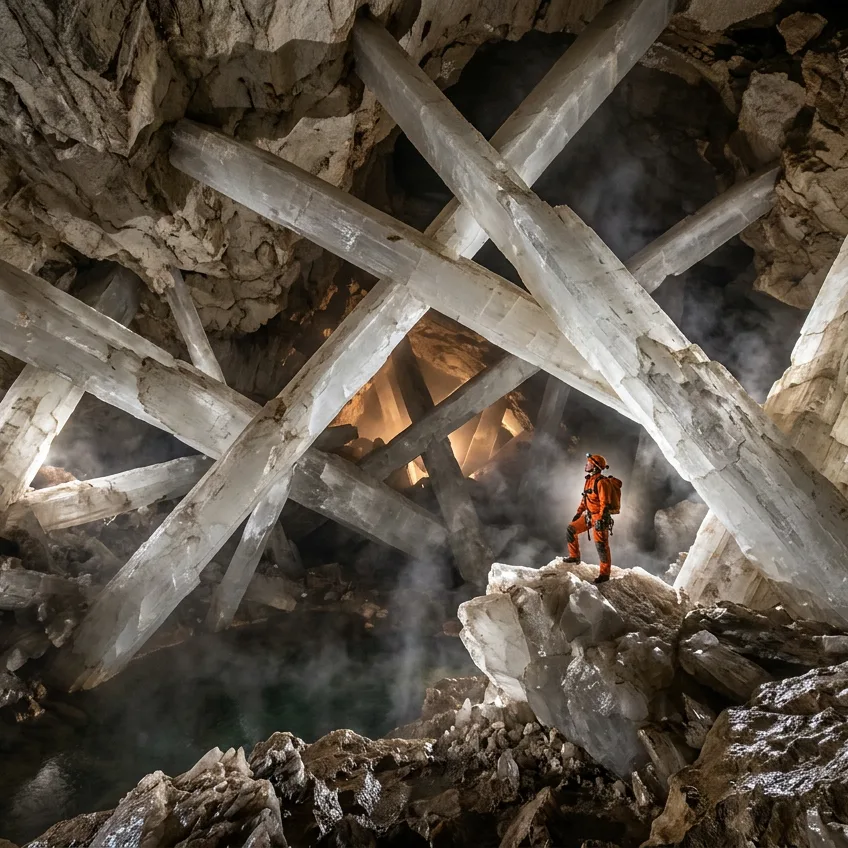
At 300 meters beneath the hills of the Chihuahua desert, in Mexico, lies one of the most alien and extreme geological landscapes on Earth: the Naica Cave of the Crystals. Accidentally discovered in the year 2000 by two miners excavating a drainage tunnel, this underground cavity houses gigantic translucent prisms of selenite (a crystalline variety of gypsum) that reach up to 11.4 meters in length and weigh more than 50 tons each.
The origin of these enormous structures required an almost miraculous thermodynamic precision. Millions of years ago, a magmatic intrusion located at great depth heated and saturated the groundwater of the complex with calcium and sulfate ions. When the temperature of this hydrothermal brine slowly dropped and stabilized within a narrow thermal window of between 54 °C and 58 °C, a perfect chemical equilibrium was reached: the water was at the exact temperature for gypsum to crystallize ceaselessly, without dissolving again.
Because the cave remained completely flooded and at that fixed, unchanging temperature for at least 500,000 consecutive years, the nucleation rate was extraordinarily slow. Instead of germinating countless small crystals, atoms were deposited layer upon layer onto a handful of initial nuclei, allowing them to grow beam by beam at an imperceptible geological pace.
Despite its beauty, Naica is a lethal environment for humans: with humidity above 90% and temperatures hovering near 60 °C, sweat cannot evaporate. Without suits equipped with internal cooling, the ambient heat would cause asphyxiation due to pulmonary condensation in less than fifteen minutes.
Source: García-Ruiz et al., Geology (Geological Society of America) - 'Formation of natural gypsum megacrystals in Naica, Mexico'