In 1972, during a routine analysis at the Pierrelatte enrichment plant in France, physicists discovered a baffling anomaly: a uranium ore sample from the Oklo deposit in Gabon contained just 0.717% uranium-235, instead of the universal, constant proportion of 0.720% found in any rock on the planet, the Moon, or meteorites.
That tiny discrepancy revealed that hundreds of kilograms of fissionable material had already been consumed. Subsequent geological investigations uncovered an astonishing truth: around 2,000 million years ago, nature built and operated at least 16 self-sustaining nuclear fission reactors beneath Earth's crust.
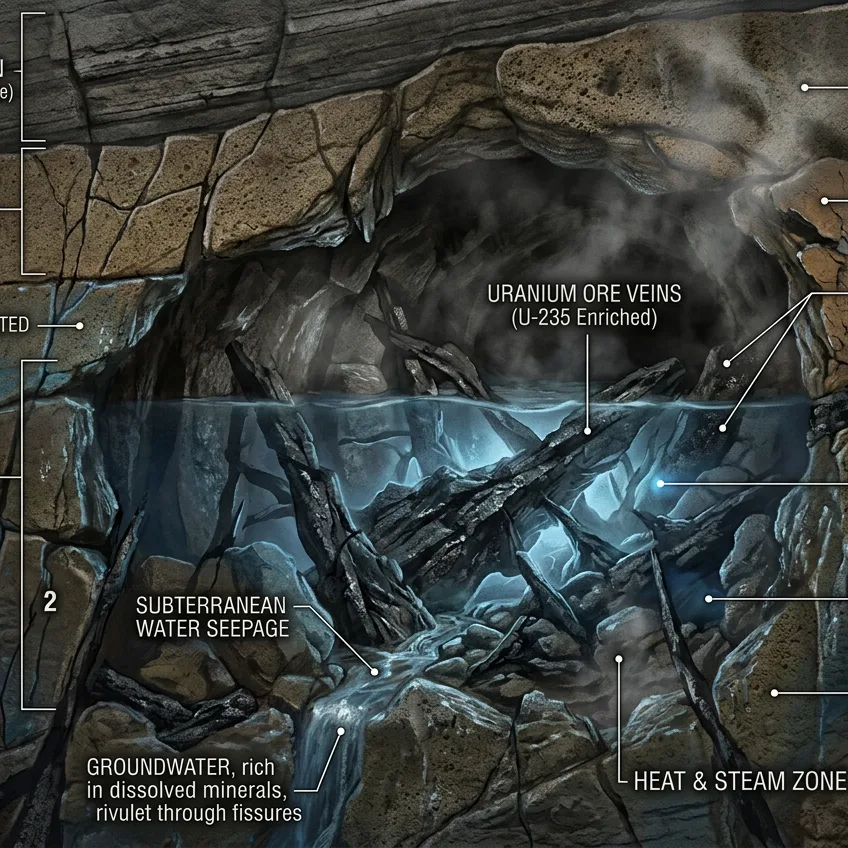
For this phenomenon to occur spontaneously, three unrepeatable conditions converged:
- Natural enrichment: In that geological era, uranium-235 had not yet decayed as much, and its natural abundance was around 3%, the same concentration required by modern nuclear power plants.
- Presence of oxygen: The recent rise of photosynthetic cyanobacteria oxygenated the groundwater, allowing uranium to dissolve and concentrate into dense sandstone strata.
- Water as a moderator: Groundwater slowed the emitted neutrons, enabling the chain reaction. When the heat boiled and evaporated the water, fission shut down completely until the system cooled down and flooded again.
This thermohydraulic cycle kept the Oklo reactor active in continuous pulses for about 300,000 years, generating a sustained average power of 100 kilowatts. Its most valuable legacy for modern science is that radioactive waste, including plutonium isotopes, remained immobilized almost intact within the rock matrix for eons.
Source: International Atomic Energy Agency (IAEA) / Scientific American