In the mid-19th century, Chicago faced a lethal crisis. Settled on a swamp on the shores of Lake Michigan, sewage stagnated in the dirt streets, unleashing devastating outbreaks of cholera and typhoid fever. The solution proposed in 1855 by engineer Ellis S. Chesbrough was visionary: build the first comprehensive storm and sanitary sewer network in the United States. However, an insurmountable topographic obstacle stood in the way: for the pipes to drain by gravity toward the river, the grade of the entire metropolis had to be raised between one and two and a half meters.
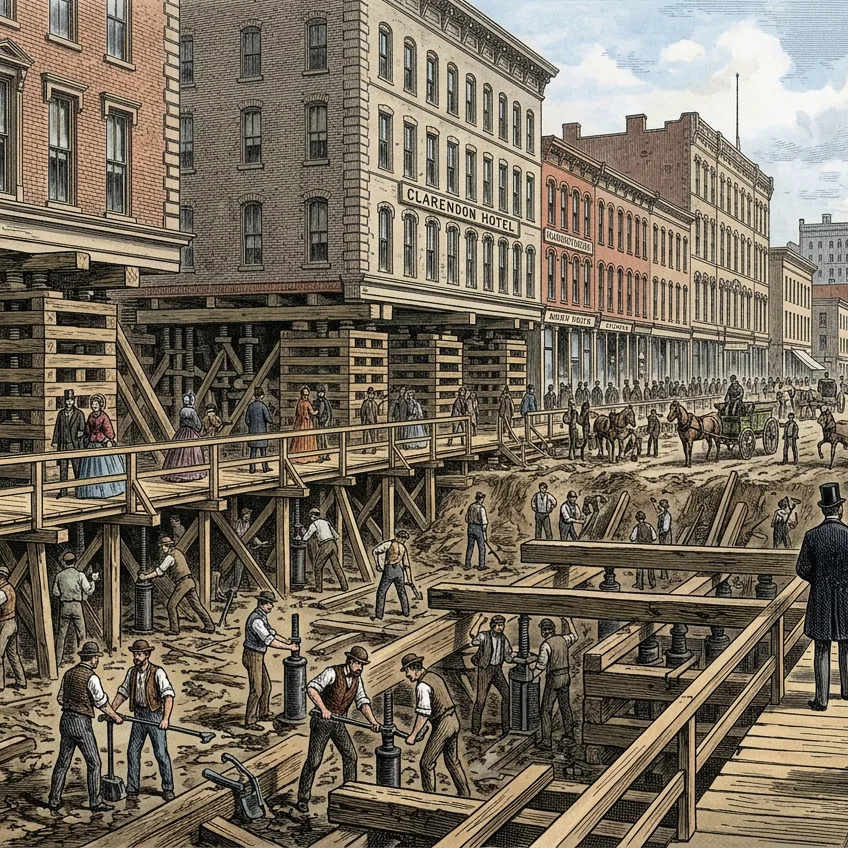
Instead of demolishing the buildings or resigning themselves to the mud, the city undertook one of the boldest engineering feats of the 19th century. For more than a decade, crews of specialists excavated beneath structures and placed thousands of mechanical screw jacks under the foundations. One of the most famous maneuvers, supervised by the renowned inventor George Pullman in 1860, raised an entire commercial block on Lake Street: half an acre of masonry and brick buildings weighing an estimated 35,000 metric tons.
The coordination required near-military discipline. Hundreds of workers moved in perfect synchrony, turning their respective jackscrews a quarter-turn at the sound of a whistle to rise mere fractions of a millimeter per pass. The most astonishing part of the operation was its precision: shops kept their doors open, customers continued shopping, and not a single pane of window glass cracked while the entire city rose slowly on its own foundations.
Source: American Society of Civil Engineers (ASCE) - Historic Landmarks