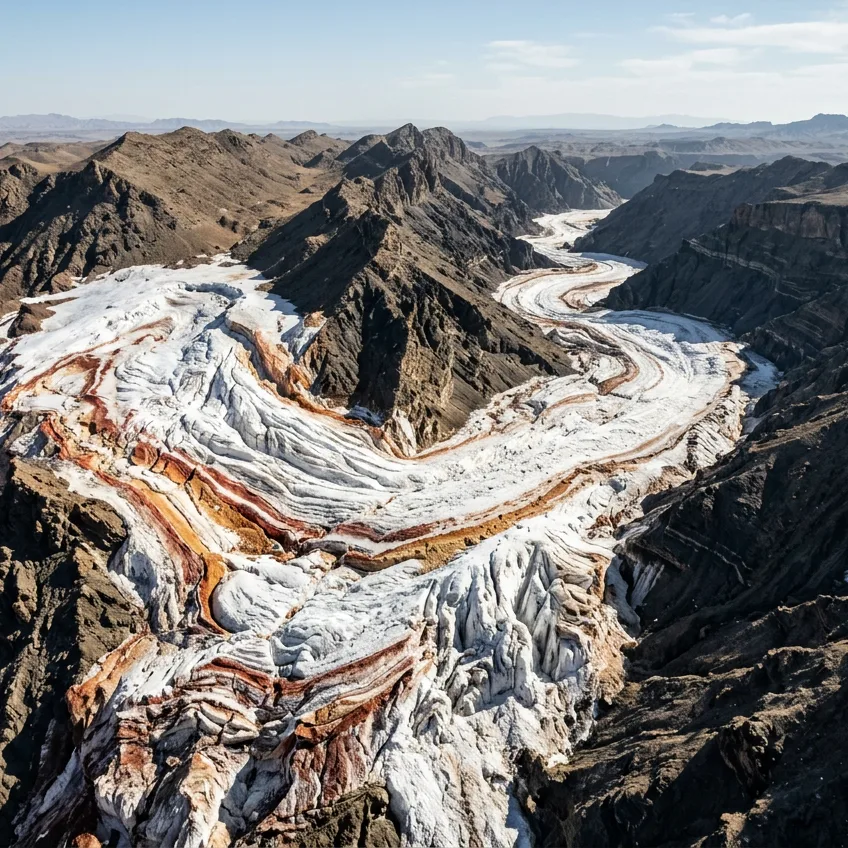
In the southern tip of Iran, in the Zagros Mountains, geology defies intuition: instead of snow or ice, there are glaciers formed entirely of pure rock salt (halite) that descend the slopes like frozen rivers in the middle of an arid, hot landscape. These phenomena, technically known as namakiers, are genuine active salt glaciers that flow, crack, and create mineral cascades.
The origin of these formations dates back more than 500 million years, when a primeval sea evaporated and left behind a massive layer of evaporite salt several kilometers thick. Over the eras, dense layers of sedimentary rock buried this bed. Because halite has a density noticeably lower than surrounding rocks and exceptional plasticity under tectonic pressure, it began pushing its way upward in gigantic ascending columns, a geological phenomenon known as diapirism.
Upon breaking through the Earth's surface, the unusual happens:
- Under extreme underground pressures and temperatures, salt crystals undergo ductile deformation at a microscopic scale, behaving like a malleable plastic solid.
- Driven by gravity, these mineral tongues hundreds of meters thick creep downhill at speeds of up to several meters per year.
- In their slow advance, they generate crevasses similar to the seracs of polar glaciers and give rise to some of the longest and most complex salt caves on the planet.
Namakiers prove that rocks are not always motionless structures: under the right forces of the Earth, even solid rock can flow like a frozen river.
Source: Geological Society of America Bulletin / NASA Earth Observatory