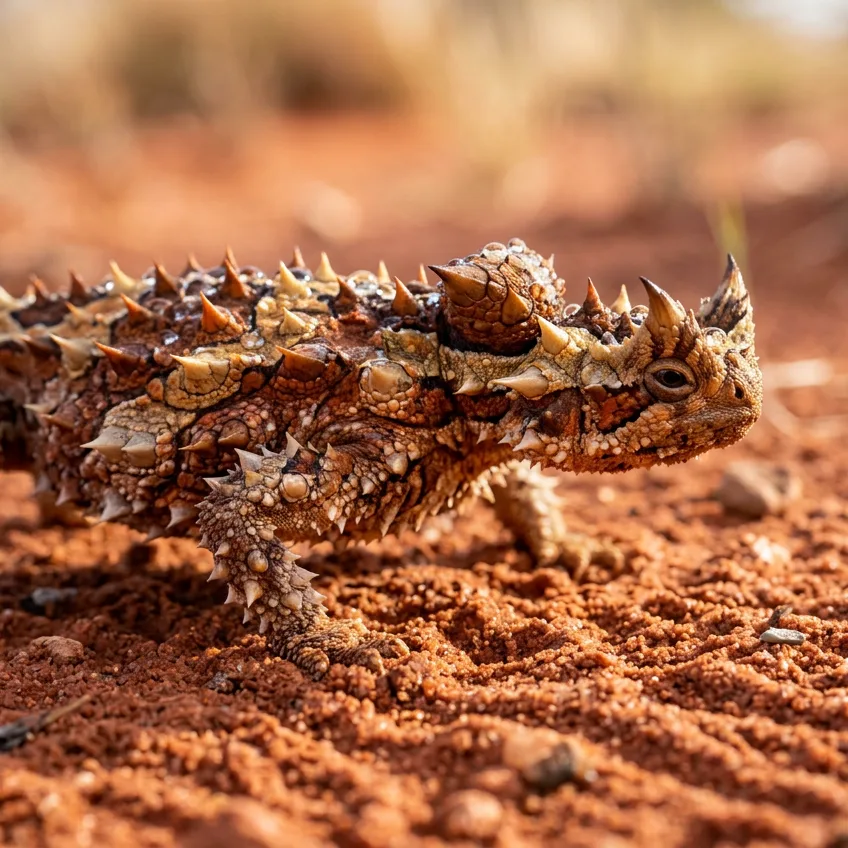
In the unforgiving deserts of Australia, where surface water is practically nonexistent, the thorny devil (Moloch horridus) has developed one of the most sophisticated moisture-harvesting systems in the animal kingdom. Despite its intimidating appearance, covered in rigid conical spines, its greatest biological wonder lies hidden in the microstructure separating its scales.
The skin of this reptile acts as an entirely passive microfluidic circuit. Between each of its scales runs an intricate network of capillary grooves measuring between 5 and 150 micrometers wide. When the lizard comes into contact with damp sand, condensation drops, or morning dew, the water's surface tension and molecular adhesion forces cause the liquid to be absorbed instantly. Water spreads via capillary action across its entire body, traveling uphill and against gravity.
The channels converge with geometric precision at the corners of its jaw. When the flow reaches its face, the animal only needs to make rhythmic mouth movements to swallow the collected liquid, with no need to submerge its head or lick the ground. Biomechanical experiments have shown that it is enough for the thorny devil to place merely its hind feet on moist sand for water to travel up its back to its mouth in a matter of minutes.
This biophysical mechanism has caught the attention of modern engineering, inspiring new biomaterials to transport fluids without mechanical pumps and harvest fog water in extreme desert areas.
Source: Journal of Experimental Biology (Research by Philipp Comanns et al., 2016)