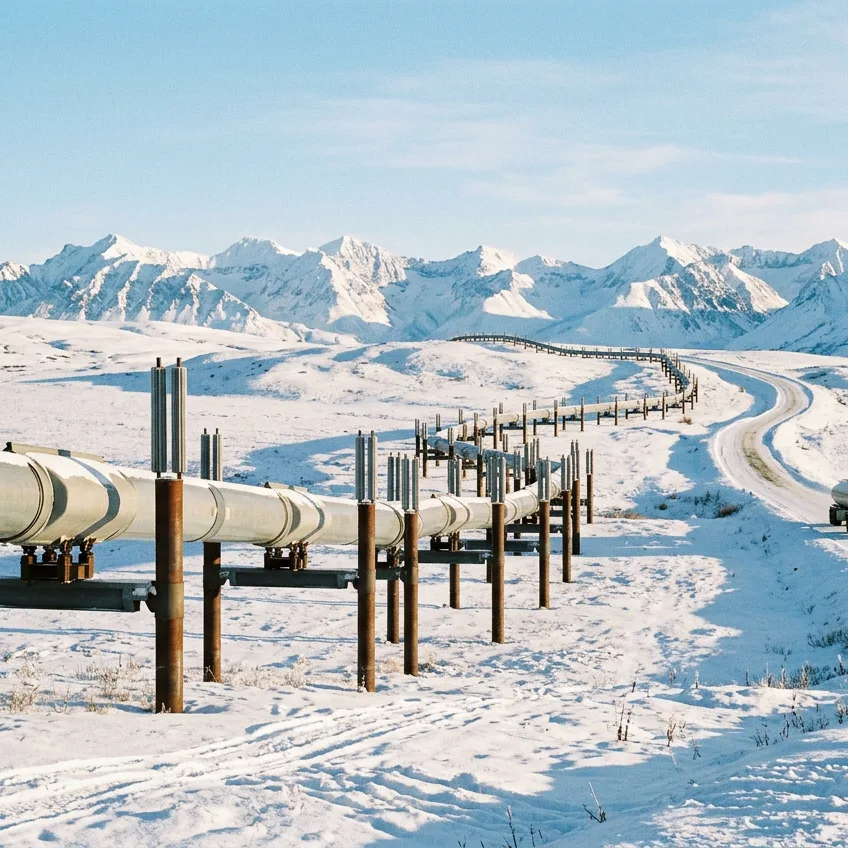
Building the Trans-Alaska Pipeline System (TAPS) in the 1970s meant challenging extreme conditions along 1,287 kilometers, but its greatest test was not the Arctic ice, but crossing the formidable Denali Fault. Aware that a devastating earthquake was inevitable, engineers rejected laying the line straight and instead designed a continuous zigzag path elevated on movable Teflon supports.
This geometry prevented the 122-centimeter-diameter steel pipe from being subjected to fatal shear forces. Rather than being rigidly anchored to the ground, it rested on shoes able to slide freely from side to side across horizontal mild steel beams, turning the colossal metal structure into a flexible accordion capable of absorbing extreme seismic compressions and expansions.
The ultimate test arrived on November 3, 2002, when the Denali earthquake struck the region with a magnitude of 7.9. The fault ruptured violently right beneath the pipeline, shifting the ground 5.5 meters horizontally and nearly one meter vertically. Thanks to its articulated design, the pipe slid from one end of its supports to the other, absorbed the kinetic whip, and did not spill a single drop of crude, sealing one of the greatest milestones of modern earthquake engineering.
Source: United States Geological Survey (USGS)