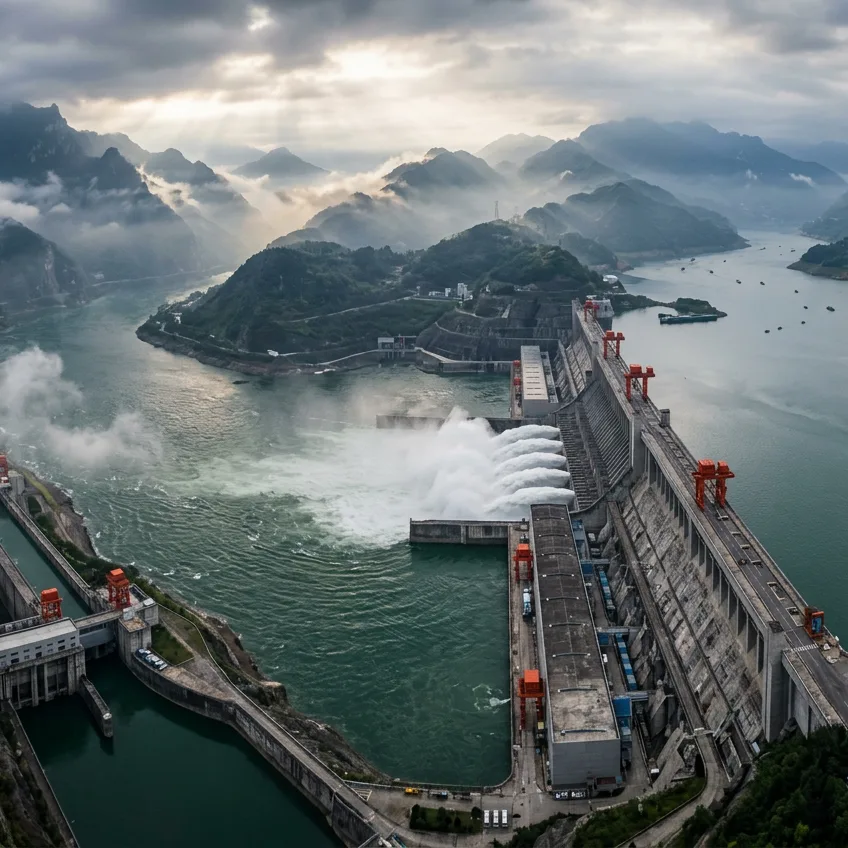
Fully inaugurated in 2012 after nearly two decades of work, the Three Gorges Dam on the Yangtze River, in China, holds the record for being the most powerful hydroelectric plant on the planet. With a length of more than 2.3 kilometers and a height of 181 meters, its construction required pouring nearly twenty-eight million cubic meters of concrete and using enough steel to build more than sixty Eiffel Towers.
However, the greatest surprise of this monumental civil engineering feat lies not only in its 22,500 megawatts of installed capacity, but in its unusual global geophysical impact:
- A massive mass: The filling of its colossal reservoir, which extends over more than 600 kilometers, trapped around 39,300 million cubic meters of water, raising about forty billion tons to 175 meters above sea level.
- Planetary physics: According to calculations made in 2005 by geophysicists at NASA's Goddard Space Flight Center, moving such a volume of water to a higher altitude increased Earth's moment of inertia, a phenomenon identical to an ice skater extending their arms to spin more slowly.
- The measurable result: The accumulation of this liquid mass slowed Earth's rotation, lengthening the length of the day by approximately 0.06 microseconds (60 nanoseconds) and shifting the position of Earth's pole axis by about two centimeters.
This colossal human work demonstrated how modern engineering reached sufficient scale to intervene not only in river channels, but also in the orbital parameters of our own planet.
Source: NASA Goddard Space Flight Center / NASA Jet Propulsion Laboratory (geophysical studies by Dr. Benjamin Fong Chao on mass redistribution and Earth rotation).