Beneath the streets of Saitama Prefecture, on the northern edge of Tokyo, lies one of the most colossal civil engineering works on the planet: the Metropolitan Area Outer Underground Discharge Channel, popularly known as G-Cans. Built between 1993 and 2006 with a budget of more than 2,000 million dollars, this gigantic drainage network was designed to protect nearly forty million residents from the devastating typhoons and torrential rains that strike Japan.
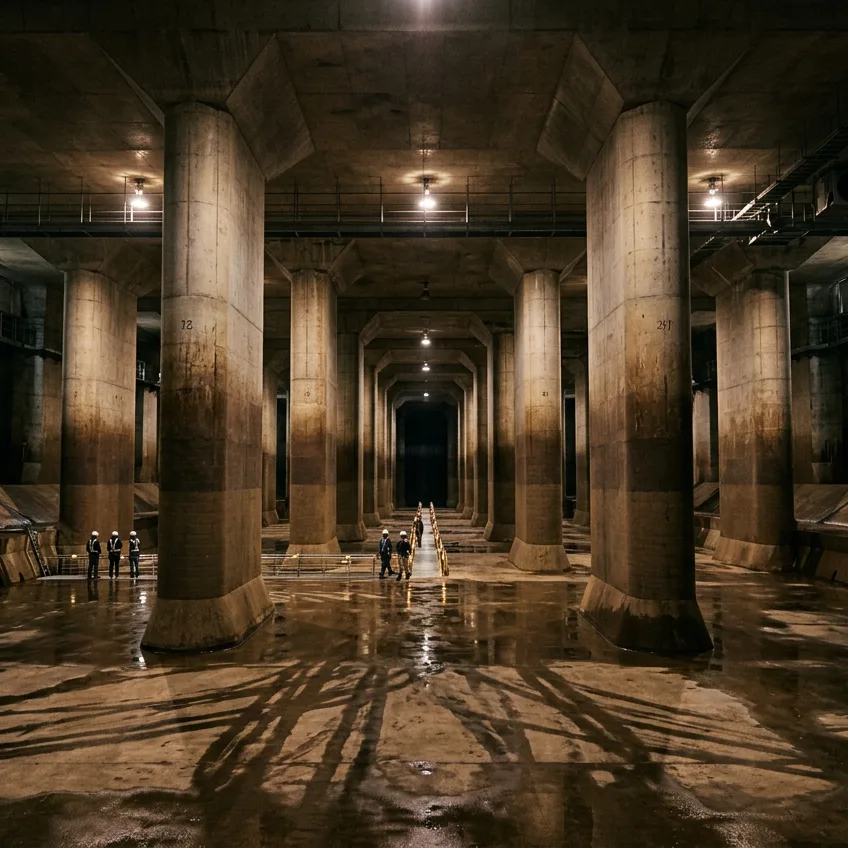
The heart of this infrastructure is a monumental pressure-adjusting water tank located fifty meters underground, known as the "Underground Temple." Measuring 177 meters in length, 78 meters in width, and 18 meters in height, its ceiling is supported by 59 colossal concrete pillars weighing 500 tons each. These columns not only support the weight of the ground above, but also counteract the formidable upward buoyant force exerted by groundwater when the soil becomes saturated.
The complex captures overflow from five rivers through vertical shafts 32 meters in diameter, wide enough to hold a space shuttle. When water reaches the main chamber, four gas turbines derived from aircraft jet engines power pumps that drive up to 200 cubic meters per second directly into the Edo River. This rate is equivalent to draining an entire Olympic swimming pool in just twelve seconds, managing to reduce historic flood damage in the Japanese capital by more than 80%.
Source: Ministry of Land, Infrastructure, Transport and Tourism of Japan (MLIT)