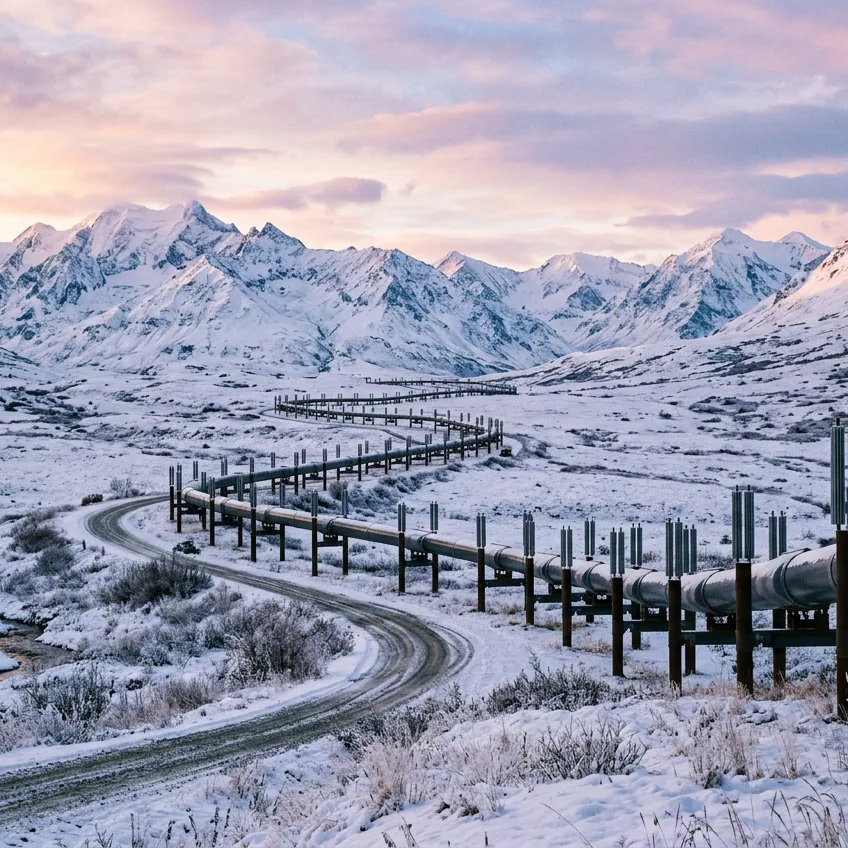
On November 3, 2002, a devastating magnitude 7.9 earthquake shook the Denali Fault in Alaska. At the rupture point, the Earth's crust shifted horizontally by about 5.5 meters right beneath the Trans-Alaska Pipeline System (TAPS), a 1,287-kilometer artery transporting oil across tundras and mountains. Despite the violence of the quake, the pipeline suffered no leaks and not a single drop of crude oil was spilled.
This achievement was not a stroke of luck, but the triumph of an extraordinary work of earthquake engineering. When planning the project in the 1970s, engineers knew that crossing active tectonic faults required flexibility. Instead of burying the pipe or laying it in a straight line, they designed an aboveground continuous zigzag route supported on steel crossbeams with shoes coated in Teflon. When the earthquake fractured the ground, the pipe did not collapse under tension: it slid smoothly over its supports and expanded like an accordion to absorb the tectonic displacement.
In addition to the seismic challenge, the project had to resolve the problem of permafrost. Since the crude travels at over 40 °C, the heat threatened to melt the frozen ground and cause the foundations to sink into the mud. The solution was to top the vertical support members with more than 124,000 thermosyphons: closed ammonia tubes that passively extract heat from the ground and vent it into the atmosphere without consuming a single watt of energy, keeping the tundra permanently solid.
Source: United States Geological Survey (USGS) & American Society of Civil Engineers (ASCE)